Skip to main content
General Chemistry
My Course
Learn
Exam Prep
AI Tutor
Study Guides
Textbook Solutions
Flashcards
Explore
My Course
Learn
Exam Prep
AI Tutor
Study Guides
Textbook Solutions
Flashcards
Explore
Back
Intermolecular Forces definitions
You can tap to flip the card.
Intramolecular Forces
You can tap to
flip the card.
👆
Intramolecular Forces
Strong bonds within a molecule, influencing chemical properties, such as ionic and covalent bonds.
Track progress
Control buttons has been changed to "navigation" mode.
1/15
Related flashcards
Related practice
Recommended videos
Guided course
01:59
Intermolecular vs Intramolecular Forces
Jules
Guided course
2:04
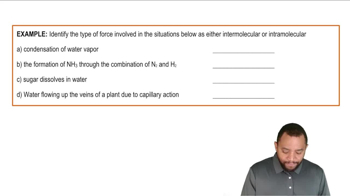
Intermolecular vs Intramolecular Example
Jules
Guided course
06:44
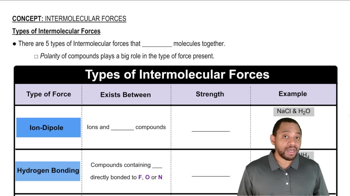
Types of Intermolecular Forces
Jules
Terms in this set (15)
Hide definitions
Intramolecular Forces
Strong bonds within a molecule, influencing chemical properties, such as ionic and covalent bonds.
Intermolecular Forces
Weaker forces between molecules, affecting physical properties and holding liquids and solids together.
Electronegativity
A measure of an atom's ability to attract and hold electrons, influencing molecular polarity.
Ion-Dipole Forces
Strongest intermolecular force between ions and polar molecules, common in ionic compounds dissolved in water.
Hydrogen Bonding
Attractive force when hydrogen is bonded to fluorine, oxygen, or nitrogen, second strongest intermolecular force.
Dipole-Dipole Interactions
Attractive forces between two polar molecules, third in strength among intermolecular forces.
London Dispersion Forces
Weakest intermolecular force present in all compounds, caused by temporary dipoles in close proximity.
Polarity
Distribution of electrical charge over atoms in a molecule, affecting intermolecular force type.
Aqueous
Describes ions or molecules dissolved in water, often involved in ion-dipole interactions.
Solvation
Process of surrounding solute particles with solvent molecules, stabilizing them in solution.
Van der Waals Forces
Another term for London dispersion forces, weak attractions between nonpolar molecules.
Partial Charge
Slight electrical charge on atoms due to differences in electronegativity, leading to molecular attraction.
Covalent Bonds
Strong intramolecular bonds formed by sharing electrons between atoms within a molecule.
Ionic Bonds
Strong intramolecular bonds formed by the transfer of electrons, creating charged ions.
Molecular Polarity
Characteristic of molecules with uneven distribution of charges, influencing intermolecular interactions.
 Back
Back
 Back
Back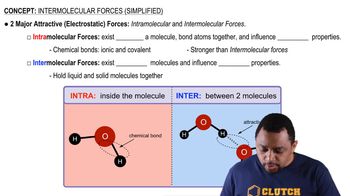
 01:59
01:59