Skip to main content
General Chemistry
My Course
Learn
Exam Prep
AI Tutor
Study Guides
Textbook Solutions
Flashcards
Explore
My Course
Learn
Exam Prep
AI Tutor
Study Guides
Textbook Solutions
Flashcards
Explore
Back
Hydrogenation Reactions definitions
You can tap to flip the card.
Hydrogenation
You can tap to
flip the card.
👆
Hydrogenation
A chemical reaction involving the addition of hydrogen to unsaturated hydrocarbons, converting them into alkanes.
Track progress
Control buttons has been changed to "navigation" mode.
1/10
Related practice
Recommended videos
Guided course
01:22
Hydrogenation Reactions
Jules
Guided course
00:49
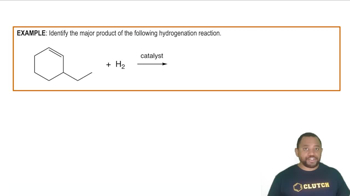
Hydrogenation Reactions Example
Jules
Terms in this set (10)
Hide definitions
Hydrogenation
A chemical reaction involving the addition of hydrogen to unsaturated hydrocarbons, converting them into alkanes.
Alkene
A hydrocarbon containing at least one carbon-carbon double bond, which can be hydrogenated to form an alkane.
Alkyne
A hydrocarbon with at least one carbon-carbon triple bond, requiring two moles of hydrogen for full hydrogenation.
Alkane
A saturated hydrocarbon with only single bonds between carbon atoms, resulting from hydrogenation.
Pi bond
A type of covalent bond formed by the sideways overlap of atomic orbitals, present in alkenes and alkynes.
Catalyst
A substance, often a metal, that increases the rate of hydrogenation by facilitating the breaking of hydrogen bonds.
Metal catalyst
A specific type of catalyst used in hydrogenation to break the hydrogen-hydrogen bond efficiently.
Saturation
The state of a hydrocarbon chain when all carbon-carbon bonds are single, achieved through hydrogenation.
Hydrocarbon
An organic compound consisting entirely of hydrogen and carbon, which can be unsaturated or saturated.
Reagent
A substance or compound added to a system to cause a chemical reaction, such as hydrogen in hydrogenation.
 Back
Back
 Back
Back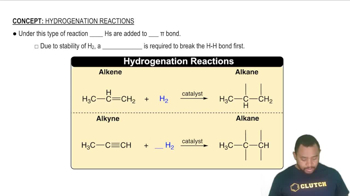
 01:22
01:22