Skip to main content
General Chemistry
My Course
Learn
Exam Prep
AI Tutor
Study Guides
Textbook Solutions
Flashcards
Explore
My Course
Learn
Exam Prep
AI Tutor
Study Guides
Textbook Solutions
Flashcards
Explore
Back
Halogenation Reactions definitions
You can tap to flip the card.
Halogenation
You can tap to
flip the card.
👆
Halogenation
A reaction involving the addition of halogens to unsaturated hydrocarbons, transforming them into more reactive compounds.
Track progress
Control buttons has been changed to "navigation" mode.
1/10
Related practice
Recommended videos
Guided course
01:11
Halogenation Reactions
Jules
Guided course
00:47
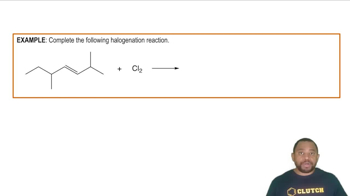
Halogenation Reactions Example
Jules
Terms in this set (10)
Hide definitions
Halogenation
A reaction involving the addition of halogens to unsaturated hydrocarbons, transforming them into more reactive compounds.
Alkene
A hydrocarbon containing a carbon-carbon double bond, which can undergo halogenation to form dihalides.
Alkyne
A hydrocarbon with two carbon-carbon pi bonds, requiring two moles of halogen for complete halogenation.
Pi bond
A type of covalent bond formed by the sideways overlap of p orbitals, present in alkenes and alkynes.
Dihalide
A compound formed when two halogen atoms are added to an alkene during halogenation.
Tetrahalide
A compound resulting from the addition of four halogen atoms to an alkyne in a halogenation reaction.
Reagent
A substance or compound added to a system to cause a chemical reaction, such as halogens in halogenation.
Bromine
A halogen element used in halogenation reactions to add to pi bonds in alkenes and alkynes.
Chlorine
A halogen element that can react with alkenes and alkynes to form dihalides and tetrahalides.
Unsaturated hydrocarbon
A hydrocarbon with one or more pi bonds, capable of undergoing halogenation to form halogenated compounds.
 Back
Back
 Back
Back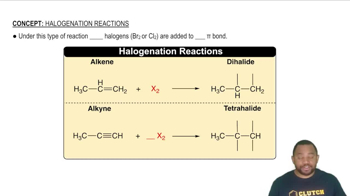
 01:11
01:11