Skip to main content
General Chemistry
My Course
Learn
Exam Prep
AI Tutor
Study Guides
Textbook Solutions
Flashcards
Explore
My Course
Learn
Exam Prep
AI Tutor
Study Guides
Textbook Solutions
Flashcards
Explore
Back
Galvanic Cell definitions
You can tap to flip the card.
Galvanic Cell
You can tap to
flip the card.
👆
Galvanic Cell
A type of electrochemical cell that generates electricity through spontaneous redox reactions.
Track progress
Control buttons has been changed to "navigation" mode.
1/15
Related practice
Recommended videos
Guided course
01:08
The Galvanic Cell
Jules
Guided course
00:49
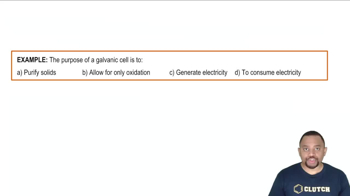
Galvanic Cell Example
Jules
Guided course
03:55
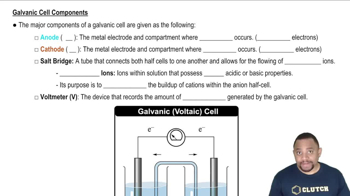
Galvanic Cell Components
Jules
Terms in this set (15)
Hide definitions
Galvanic Cell
A type of electrochemical cell that generates electricity through spontaneous redox reactions.
Anode
The negatively charged electrode where oxidation occurs, losing electrons and decreasing in mass over time.
Cathode
The positively charged electrode where reduction occurs, gaining electrons and increasing in mass over time.
Redox Reaction
A chemical reaction involving the transfer of electrons, comprising oxidation and reduction processes.
Salt Bridge
A tube containing neutral ions that connects two half-cells, maintaining charge balance by neutralizing excess ions.
Standard Cell Potential
The voltage difference between two electrodes in a galvanic cell, positive for spontaneous reactions.
Voltmeter
A device that measures the voltage or electrical potential difference between two points in a circuit.
Electrode
A conductor through which electricity enters or leaves a medium, such as the anode or cathode in a cell.
Neutral Ions
Ions that do not exhibit acidic or basic properties, used in salt bridges to maintain charge neutrality.
Spontaneous Reaction
A reaction that occurs naturally under given conditions, often with a positive cell potential.
Equilibrium
A state where a galvanic cell has used all its electricity, with no net change in reactants or products.
Gibbs Free Energy
A thermodynamic quantity representing the amount of energy available to do work, negative for spontaneous reactions.
Entropy
A measure of disorder or randomness in a system, increasing in spontaneous processes.
Equilibrium Constant
A ratio of product concentrations to reactant concentrations at equilibrium, greater than 1 for spontaneous reactions.
Conductive Wire
A medium through which electrons flow from the anode to the cathode, generating electricity.
 Back
Back
 Back
Back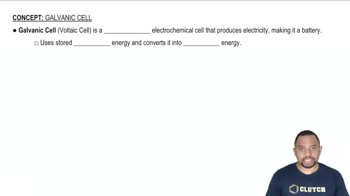
 01:08
01:08