Skip to main content
General Chemistry
My Course
Learn
Exam Prep
AI Tutor
Study Guides
Textbook Solutions
Flashcards
Explore
My Course
Learn
Exam Prep
AI Tutor
Study Guides
Textbook Solutions
Flashcards
Explore
Back
Formation Equations definitions
You can tap to flip the card.
Periodic Table
You can tap to
flip the card.
👆
Periodic Table
A tabular arrangement of chemical elements, organized by atomic number, electron configuration, and recurring chemical properties.
Track progress
Control buttons has been changed to "navigation" mode.
1/15
Related practice
Recommended videos
Guided course
02:27
Formation Equations
Jules
Guided course
00:46
Formation Equations Example 1
Jules
Guided course
02:32
Formation Equations Example 2
Jules
Terms in this set (15)
Hide definitions
Periodic Table
A tabular arrangement of chemical elements, organized by atomic number, electron configuration, and recurring chemical properties.
Standard States
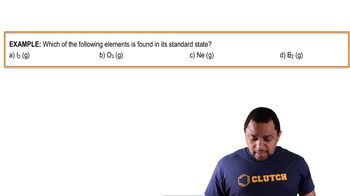
The physical state of an element at room temperature (25°C) and standard pressure (1 atm).
Monoatomic
Consisting of single atoms, not bonded to each other, as seen in noble gases like helium.
Diatomic
Molecules composed of two atoms, such as hydrogen (H2) and oxygen (O2).
Polyatomic
Molecules consisting of more than two atoms, like phosphorus (P4) and sulfur (S8).
Noble Gases
A group of monoatomic gases in the periodic table, including helium and radon, known for their inertness.
Room Temperature
A standard condition of approximately 25 degrees Celsius used to describe the state of elements.
Standard Pressure
A standard condition of approximately one atmosphere used to describe the state of elements.
Phases
The distinct forms in which matter can exist: solid, liquid, and gas.
Helium
A noble gas that is monoatomic and exists as a gas at room temperature.
Bromine
A diatomic element that is one of the few liquids at room temperature.
Mercury
A monoatomic element that is a liquid at room temperature.
Phosphorus
A polyatomic element existing as P4 in its natural state.
Sulfur
A polyatomic element existing as S8 in its natural state.
Iodine
A diatomic element existing as I2 in its natural state.
 Back
Back
 Back
Back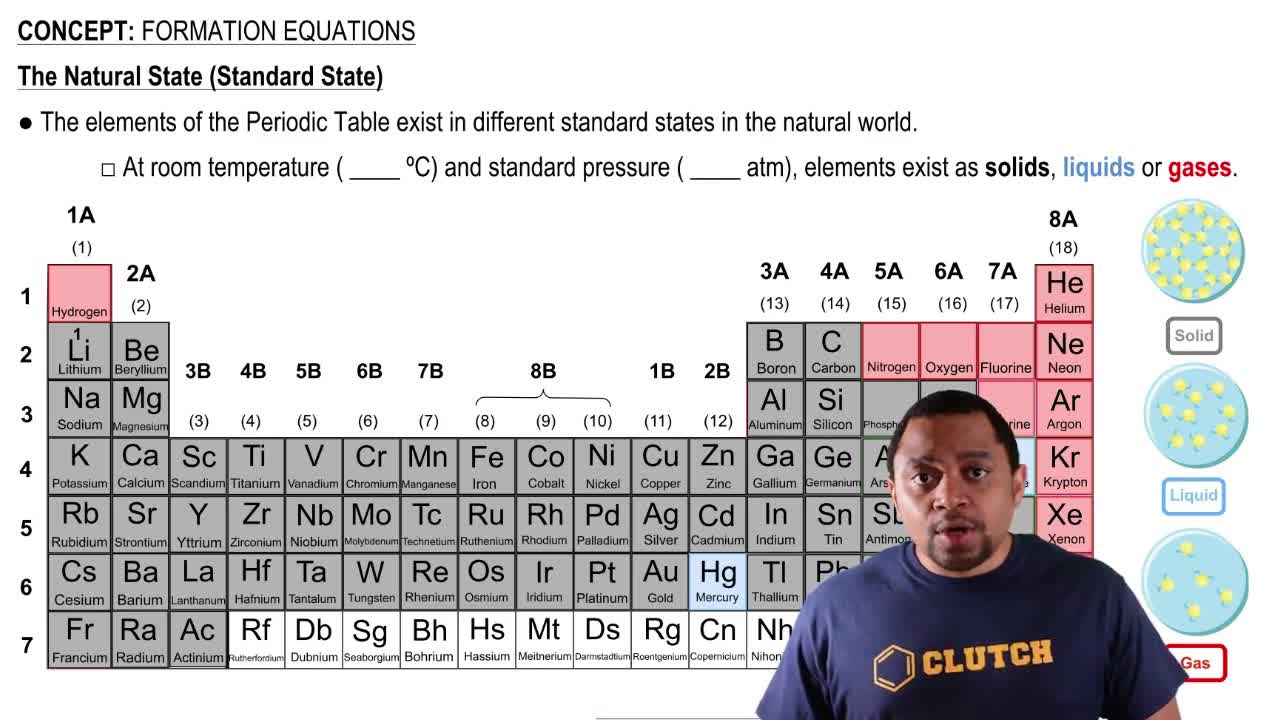
 02:27
02:27