Skip to main content
General Chemistry
My Course
Learn
Exam Prep
AI Tutor
Study Guides
Textbook Solutions
Flashcards
Explore
My Course
Learn
Exam Prep
AI Tutor
Study Guides
Textbook Solutions
Flashcards
Explore
Back
Ester Reactions: Saponification definitions
You can tap to flip the card.
Saponification
You can tap to
flip the card.
👆
Saponification
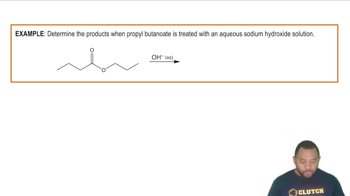
A reaction where hydroxide ions cleave an ester bond, forming a carboxylate anion and an alcohol.
Track progress
Control buttons has been changed to "navigation" mode.
1/10
Related practice
Recommended videos
Guided course
01:25
Ester Reactions: Saponification
Jules
Guided course
00:41
Ester Reactions Saponification Example
Jules
Terms in this set (10)
Hide definitions
Saponification
A reaction where hydroxide ions cleave an ester bond, forming a carboxylate anion and an alcohol.
Hydroxide ion
An ion with a negative charge, OH-, that reacts with esters in saponification.
Ester
A compound that reacts with hydroxide ions in saponification to form a carboxylate anion and alcohol.
Carboxylate anion
The negatively charged conjugate base of a carboxylic acid formed in saponification.
Alcohol
A product of saponification formed when an ester bond is cleaved by hydroxide ions.
Conjugate base
A species formed by the loss of a proton (H+) from a carboxylic acid, resulting in a negative charge.
Esterification
The process opposite to saponification, where an ester is formed from an alcohol and a carboxylic acid.
Carboxylic acid
An acid that loses an H+ to form a carboxylate anion during saponification.
Aqueous
A term describing a solution where water is the solvent, as in aqueous OH- used in saponification.
Carbonyl
A functional group consisting of a carbon atom double-bonded to an oxygen atom, involved in ester bonds.
 Back
Back
 Back
Back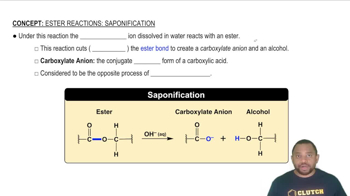
 01:25
01:25