Skip to main content
General Chemistry
My Course
Learn
Exam Prep
AI Tutor
Study Guides
Textbook Solutions
Flashcards
Explore
My Course
Learn
Exam Prep
AI Tutor
Study Guides
Textbook Solutions
Flashcards
Explore
Back
Equilibrium Constant K definitions
You can tap to flip the card.
Equilibrium Constant
You can tap to
flip the card.
👆
Equilibrium Constant
Indicates the favored direction of a reaction at equilibrium, based on the ratio of product to reactant concentrations.
Track progress
Control buttons has been changed to "navigation" mode.
1/15
Related practice
Recommended videos
Guided course
01:14
Equilibrium Constant K
Jules
Guided course
03:20
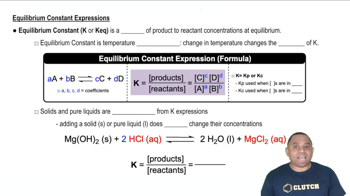
Equilibrium Constant Expressions
Jules
Guided course
01:07
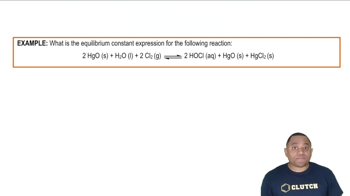
Equilibrium Constant Expressions Example
Jules
Terms in this set (15)
Hide definitions
Equilibrium Constant
Indicates the favored direction of a reaction at equilibrium, based on the ratio of product to reactant concentrations.
Rate Constant
Relates to the speed of a chemical reaction, with units including time, such as seconds inverse.
Chemical Equilibrium
A state where forward and reverse reactions occur at the same rate, with no net change in concentrations.
Equilibrium Expression
A formula representing the ratio of product to reactant concentrations, excluding solids and pure liquids.
Temperature Dependence
The characteristic of the equilibrium constant to change value with temperature variations.
Kp
An equilibrium constant used when concentration units are in atmospheres.
Kc
An equilibrium constant used when concentration units are in molarity.
Magnitude of K
Indicates whether products or reactants are favored, based on whether K is greater than, less than, or equal to 1.
Forward Reaction
The direction of a reaction that produces more products, favored when K is greater than 1.
Reverse Reaction
The direction of a reaction that produces more reactants, favored when K is less than 1.
Coefficient
A number in front of a reactant or product in a chemical equation, used as an exponent in equilibrium expressions.
Products
Substances formed from a chemical reaction, appearing in the numerator of the equilibrium expression.
Reactants
Substances consumed in a chemical reaction, appearing in the denominator of the equilibrium expression.
Solids and Pure Liquids
Excluded from equilibrium expressions as their concentrations do not change with pressure.
Chemical Kinetics
The study of reaction rates and the factors affecting them, related to the rate constant.
 Back
Back
 Back
Back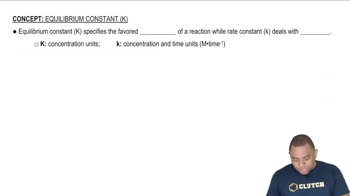
 01:14
01:14