Skip to main content
General Chemistry
My Course
Learn
Exam Prep
AI Tutor
Study Guides
Textbook Solutions
Flashcards
Explore
My Course
Learn
Exam Prep
AI Tutor
Study Guides
Textbook Solutions
Flashcards
Explore
Back
Distillation & Floatation definitions
You can tap to flip the card.
Distillation
You can tap to
flip the card.
👆
Distillation
A technique to separate components of a mixture based on differences in boiling points.
Track progress
Control buttons has been changed to "navigation" mode.
1/15
Related flashcards
Recommended videos
Guided course
12:45
Distillation and Floatation
Jules
Terms in this set (15)
Hide definitions
Distillation
A technique to separate components of a mixture based on differences in boiling points.
Simple Distillation
A method effective for separating substances with boiling point differences over 25°C.
Fractional Distillation
A method using a fractional column to separate substances with close boiling points.
Fractional Column
A column with beads that increases surface area and prolongs gas travel in distillation.
Boiling Point
The temperature at which a liquid turns into vapor.
Vaporization
The process of a liquid turning into a gas.
Condensation
The process of a gas turning back into a liquid.
Liebig Condenser
An apparatus used to cool vapor back into liquid during distillation.
Mole Fraction
The ratio of moles of a component to the total moles in a mixture.
Filtrate
The liquid collected after a separation process like distillation.
Heterogeneous Mixture
A mixture where components are in different phases and maintain individual properties.
Methanol
An alcohol with a boiling point of 67°C, often used in distillation examples.
Ethanol
An alcohol with a boiling point of 97°C, used in distillation to illustrate separation.
Bunsen Burner
A heat source used in laboratory settings to heat mixtures.
Hot Plate
A device used to heat substances in a controlled manner during experiments.
 Back
Back
 Back
Back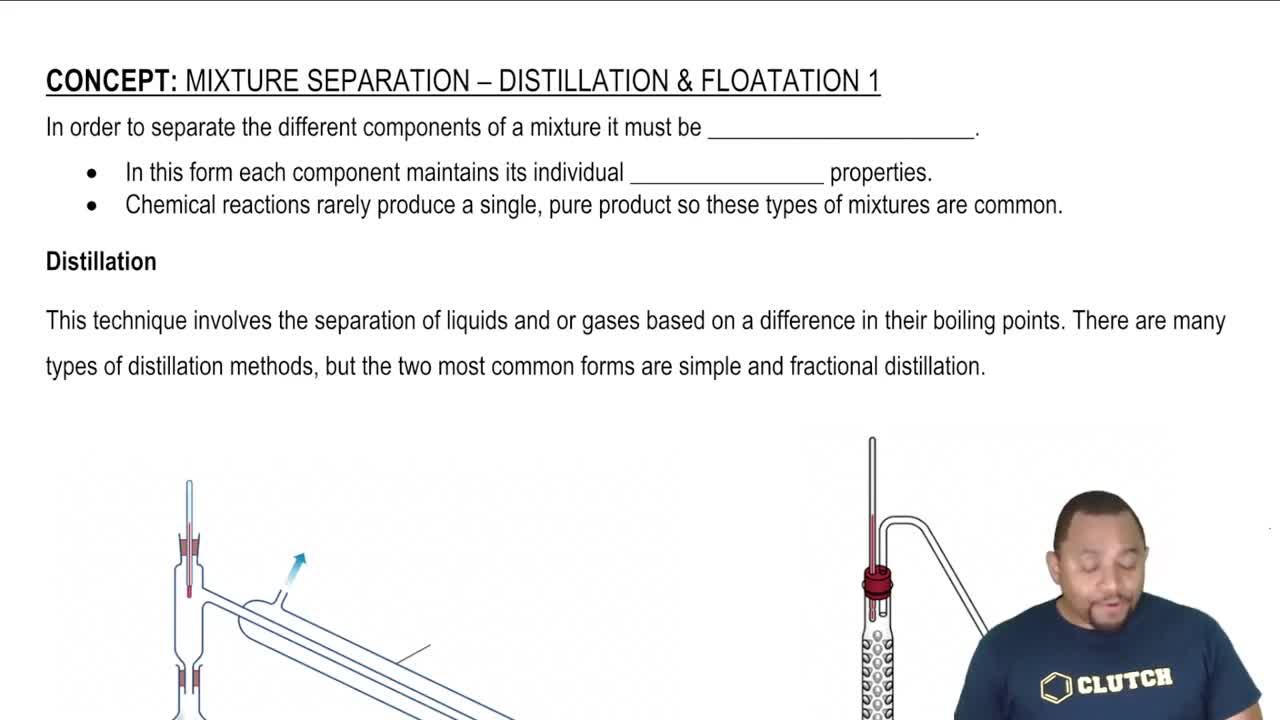
 12:45
12:45