Skip to main content
General Chemistry
My Course
Learn
Exam Prep
AI Tutor
Study Guides
Textbook Solutions
Flashcards
Explore
My Course
Learn
Exam Prep
AI Tutor
Study Guides
Textbook Solutions
Flashcards
Explore
Back
Density definitions
You can tap to flip the card.
Density
You can tap to
flip the card.
👆
Density
The ratio of mass to volume, varying by phase of matter, with units like g/mL for liquids and g/L for gases.
Track progress
Control buttons has been changed to "navigation" mode.
1/12
Related flashcards
Related practice
Recommended videos
Guided course
01:56
Density Concepts
Jules
Guided course
05:30
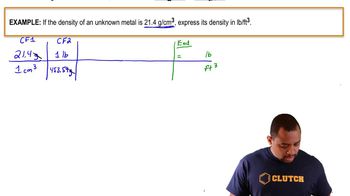
Density Conversion Example
Jules
Terms in this set (12)
Hide definitions
Density
The ratio of mass to volume, varying by phase of matter, with units like g/mL for liquids and g/L for gases.
Mass
The amount of matter in an object, typically measured in grams in the context of density.
Volume
The space occupied by a substance, measured in units like milliliters or liters for density calculations.
Grams
A metric unit of mass used in density calculations for solids, liquids, and gases.
Milliliters
A metric unit of volume equivalent to cubic centimeters, used for measuring liquids' density.
Cubic Centimeters
A unit of volume equal to a milliliter, used in density measurements for solids and liquids.
Liters
A metric unit of volume used for measuring the density of gases, equivalent to a cubic decimeter.
Cubic Decimeters
A unit of volume equivalent to a liter, used in density calculations for gases.
Solids
A phase of matter with higher density than gases, measured in g/mL or g/cm³.
Liquids
A phase of matter denser than gases, with density typically measured in g/mL or g/cm³.
Gases
A phase of matter with lower density, measured in g/L or g/dm³.
Conversion Factors
Ratios used to convert between units, such as 1 mL to 1 cm³ or 1 L to 1 dm³.
 Back
Back
 Back
Back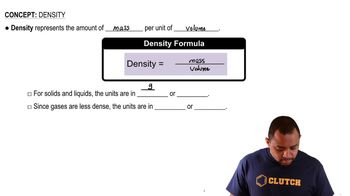
 01:56
01:56