Skip to main content
General Chemistry
My Course
Learn
Exam Prep
AI Tutor
Study Guides
Textbook Solutions
Flashcards
Explore
My Course
Learn
Exam Prep
AI Tutor
Study Guides
Textbook Solutions
Flashcards
Explore
Back
Coulomb's Law definitions
You can tap to flip the card.
Coulomb's Law
You can tap to
flip the card.
👆
Coulomb's Law
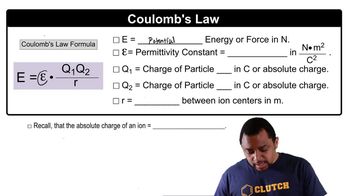
Describes the force between charged particles, proportional to charge magnitude and inversely proportional to distance.
Track progress
Control buttons has been changed to "navigation" mode.
1/10
Related practice
Recommended videos
Guided course
01:02
Coulomb's Law Concept 1
Jules
Guided course
01:15
Coulomb's Law Concept 2
Jules
Guided course
01:22
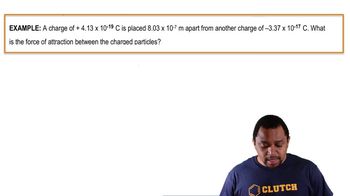
Coulomb's Law Example
Jules
Terms in this set (10)
Hide definitions
Coulomb's Law
Describes the force between charged particles, proportional to charge magnitude and inversely proportional to distance.
Potential Energy
Energy between charged particles, directly proportional to charge and inversely proportional to distance.
Permittivity Constant
A constant value of 9.0×10^9 N·m²/C² used in Coulomb's law to calculate force or energy.
Charge
A property of particles, measured in coulombs, that determines the force in Coulomb's law.
Distance
The separation between ion centers, affecting potential energy in Coulomb's law.
Ionic Bond
A bond formed by the attraction between oppositely charged ions, strength related to potential energy.
Newton
The unit of force in the International System of Units, used in Coulomb's law.
Meter
The unit of distance in the International System of Units, used in Coulomb's law.
Coulomb
The unit of electric charge, fundamental to calculations in Coulomb's law.
Absolute Charge
The charge of an ion, typically 1.602×10^-19 C, used in Coulomb's law calculations.
 Back
Back
 Back
Back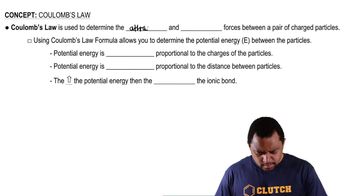
 01:02
01:02