Skip to main content
General Chemistry
My Course
Learn
Exam Prep
AI Tutor
Study Guides
Textbook Solutions
Flashcards
Explore
My Course
Learn
Exam Prep
AI Tutor
Study Guides
Textbook Solutions
Flashcards
Explore
Back
Combustion Apparatus definitions
You can tap to flip the card.
Combustion Analysis
You can tap to
flip the card.
👆
Combustion Analysis
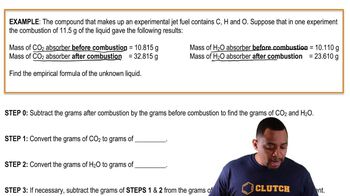
An analytical method to determine a compound's empirical formula by analyzing combustion products.
Track progress
Control buttons has been changed to "navigation" mode.
1/14
Related practice
Recommended videos
Guided course
02:24
Combustion Apparatus
Jules
Guided course
06:45
Empirical Formula via Combustion Example
Jules
Terms in this set (14)
Hide definitions
Combustion Analysis
An analytical method to determine a compound's empirical formula by analyzing combustion products.
Combustion Apparatus
A device with multiple chambers used to vaporize samples and facilitate combustion analysis.
Chamber A
The initial chamber where the sample is vaporized and oxygen gas is introduced.
Chamber B
The chamber where hydrogen in the sample is converted into water.
Chamber C
The chamber where water is trapped and nonmetals form gases.
Oxygen Gas
A reactant essential for combustion, introduced in the combustion apparatus.
Empirical Formula
A formula representing the simplest whole-number ratio of elements in a compound.
Vaporization
The process of converting a sample into a gaseous state within the apparatus.
Nonmetals
Elements in the sample that form gases like CO2, NO2, or SO2 during combustion.
Excess Oxygen
Remaining oxygen post-reaction, common in oxygen-rich environments.
CO2
A gas formed when carbon in the sample undergoes combustion.
NO2
A gas formed when nitrogen in the sample undergoes combustion.
SO2
A gas formed when sulfur in the sample undergoes combustion.
Diatomic Molecule
A molecule consisting of two atoms, formed by halogens during combustion.
 Back
Back
 Back
Back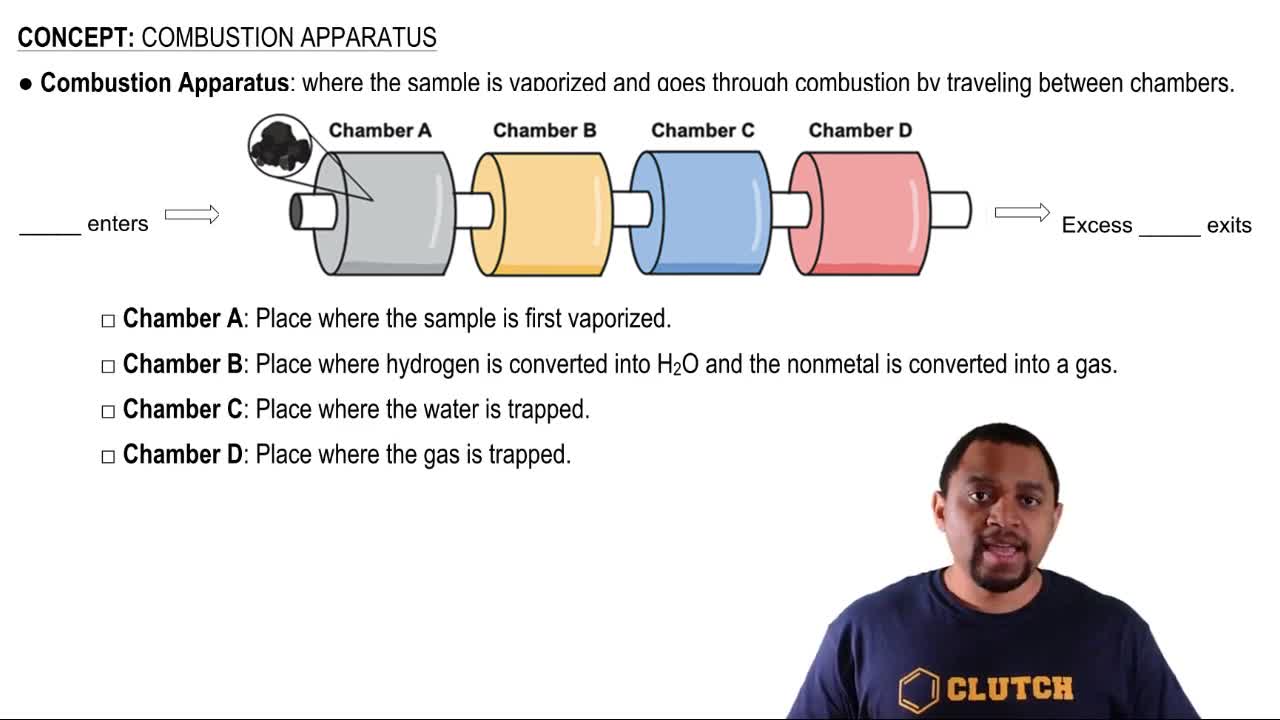
 02:24
02:24