Skip to main content
General Chemistry
My Course
Learn
Exam Prep
AI Tutor
Study Guides
Textbook Solutions
Flashcards
Explore
My Course
Learn
Exam Prep
AI Tutor
Study Guides
Textbook Solutions
Flashcards
Explore
Back
Chemistry Gas Laws: Combined Gas Law definitions
You can tap to flip the card.
Combined Gas Law
You can tap to
flip the card.
👆
Combined Gas Law
Integrates Boyle's, Charles's, and Gay-Lussac's laws to relate pressure, volume, and temperature.
Track progress
Control buttons has been changed to "navigation" mode.
1/12
Related practice
Recommended videos
Guided course
01:43
Combined Gas Law
Jules
Guided course
03:35
Combined Gas Law Example
Jules
Terms in this set (12)
Hide definitions
Combined Gas Law
Integrates Boyle's, Charles's, and Gay-Lussac's laws to relate pressure, volume, and temperature.
Boyle's Law
States that pressure and volume are inversely proportional at constant temperature.
Charles's Law
Indicates that volume is directly proportional to temperature at constant pressure.
Gay-Lussac's Law
Describes pressure as directly proportional to temperature at constant volume.
Pressure
The force exerted by gas particles per unit area on the walls of its container.
Volume
The amount of space occupied by a gas, typically measured in liters or cubic meters.
Temperature
A measure of the average kinetic energy of gas particles, affecting pressure and volume.
Proportional
A relationship where one quantity increases or decreases as another quantity does the same.
Inversely Proportional
A relationship where one quantity increases as another decreases.
Constant
A value that remains unchanged in a given mathematical relationship or equation.
Numerator
The top part of a fraction, representing the number of parts considered.
Denominator
The bottom part of a fraction, indicating the total number of equal parts.
 Back
Back
 Back
Back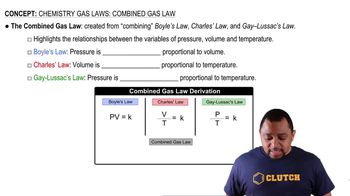
 01:43
01:43