Skip to main content
General Chemistry
My Course
Learn
Exam Prep
AI Tutor
Study Guides
Textbook Solutions
Flashcards
Explore
My Course
Learn
Exam Prep
AI Tutor
Study Guides
Textbook Solutions
Flashcards
Explore
Back
Classification of Ligands definitions
You can tap to flip the card.
Ligands
You can tap to
flip the card.
👆
Ligands
Lewis bases that donate lone pairs to metal cations, classified by the number of donor atoms.
Track progress
Control buttons has been changed to "navigation" mode.
1/15
Related practice
Recommended videos
Guided course
04:22
Ligand Classification
Jules
Guided course
01:48
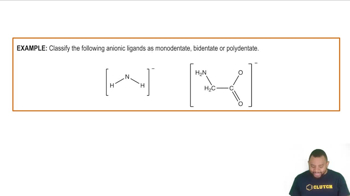
Classification of Ligands Example
Jules
Guided course
01:21
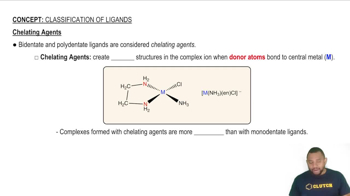
Chelating Agents
Jules
Terms in this set (15)
Hide definitions
Ligands
Lewis bases that donate lone pairs to metal cations, classified by the number of donor atoms.
Monodentate
Ligands with one donor atom that can donate a lone pair to a central metal.
Bidentate
Ligands with two donor atoms, separated by at least two other atoms, that can donate lone pairs.
Polydentate
Ligands with more than two donor atoms, capable of forming multiple bonds with metal cations.
Chelates
Stable ring structures formed when polydentate ligands bond to metal cations.
Donor atoms
Atoms in a ligand that donate lone pairs to a central metal, often negatively charged.
Hydroxide
A common monodentate ligand with a negatively charged oxygen as the donor atom.
Ammonia
A monodentate ligand where nitrogen donates a lone pair to a central metal.
Cyanide
A monodentate ligand with a negatively charged carbon as the donor atom.
Ethylenediamine
A bidentate ligand with two nitrogen donor atoms separated by two carbon atoms.
EDTA
A well-known polydentate ligand with six donor atoms, used as a preservative.
Chelating agents
Bidentate and polydentate ligands that form stable ring structures with metals.
Complex ion
A structure formed when ligands bond to a central metal, often more stable with chelating agents.
Ring structures
Formed by chelating agents in complex ions, ideally 5 or 6 membered for stability.
Oxalate
A bidentate ligand with two negatively charged oxygen donor atoms.
 Back
Back
 Back
Back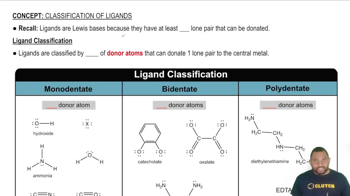
 04:22
04:22