Skip to main content
General Chemistry
My Course
Learn
Exam Prep
AI Tutor
Study Guides
Textbook Solutions
Flashcards
Explore
My Course
Learn
Exam Prep
AI Tutor
Study Guides
Textbook Solutions
Flashcards
Explore
Back
Chromatography definitions
You can tap to flip the card.
Chromatography
You can tap to
flip the card.
👆
Chromatography
A technique for separating mixture components based on molecular attractions.
Track progress
Control buttons has been changed to "navigation" mode.
1/15
Related flashcards
Recommended videos
Guided course
06:38
Chromatography
Jules
Terms in this set (15)
Hide definitions
Chromatography
A technique for separating mixture components based on molecular attractions.
Stationary Phase
The non-moving phase in chromatography, often a silica plate, that holds the mixture.
Mobile Phase
The moving phase in chromatography, typically a solvent, that carries components.
Silica Plate
A common stationary phase in chromatography where mixtures are applied.
Solvent
A liquid in the mobile phase that moves through capillary action in chromatography.
Capillary Action
The process by which the solvent moves up the stationary phase in chromatography.
Affinity
The degree of attraction between a component and the solvent or stationary phase.
TLC Plate
A thin-layer chromatography plate used to separate mixture components.
Ethanol
A slightly polar solvent often used in the mobile phase of chromatography.
Hexanes
A non-polar hydrocarbon solvent used in chromatography.
Retention Factor
The ratio of the distance traveled by a compound to the distance traveled by the solvent.
Rf Value
A numerical value representing the retention factor in chromatography.
Compound
A substance in the mixture being separated in chromatography.
Mixture
A combination of different substances that chromatography aims to separate.
Hydrocarbon
An organic compound consisting entirely of hydrogen and carbon, like hexanes.
 Back
Back
 Back
Back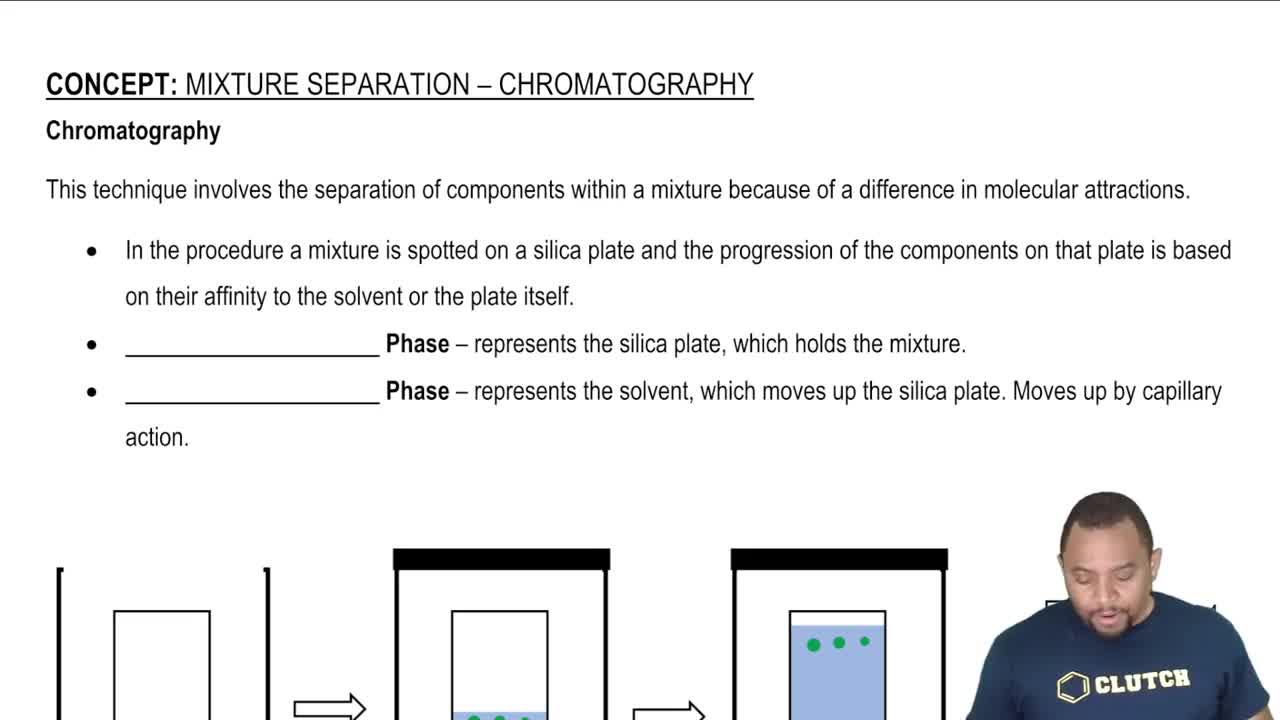
 06:38
06:38