Skip to main content
General Chemistry
My Course
Learn
Exam Prep
AI Tutor
Study Guides
Textbook Solutions
Flashcards
Explore
My Course
Learn
Exam Prep
AI Tutor
Study Guides
Textbook Solutions
Flashcards
Explore
Back
Borane Reactions definitions
You can tap to flip the card.
Borane
You can tap to
flip the card.
👆
Borane
A compound with a boron atom bonded to three hydrogen atoms, known for its electron deficiency.
Track progress
Control buttons has been changed to "navigation" mode.
1/13
Related practice
Recommended videos
Guided course
01:18
Borane Reactions
Jules
Guided course
00:44
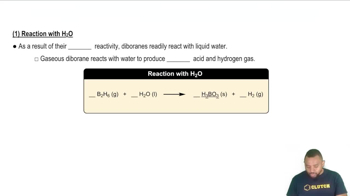
Reaction with H2O
Jules
Guided course
02:23
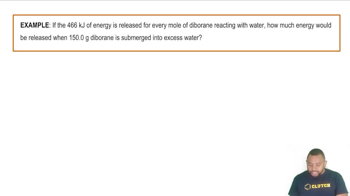
Borane Reactions Example
Jules
Terms in this set (13)
Hide definitions
Borane
A compound with a boron atom bonded to three hydrogen atoms, known for its electron deficiency.
Diborane
A highly reactive boron compound with the formula B2H6, featuring bridging hydrogens.
Electron Deficiency
A condition where an atom lacks a full octet of electrons, common in boron compounds.
Octet Rule
A chemical rule of thumb that reflects atoms' tendency to prefer having eight electrons in their valence shell.
Lewis Acid
A chemical species that can accept an electron pair, often due to electron deficiency.
Lewis Base
A chemical species that can donate an electron pair, often possessing a lone pair of electrons.
Adduct
The product formed from the direct addition of two or more distinct molecules.
Boric Acid
A compound with the formula H3BO3, formed from the reaction of diborane with water.
Hydrogen Gas
A diatomic molecule, H2, produced as a byproduct in the reaction of diborane with water.
Bridging Hydrogens
Hydrogen atoms that form bridges between two boron atoms in diborane.
Formal Charge
The charge assigned to an atom in a molecule, assuming equal sharing of electrons in bonds.
Valence Electrons
Electrons in the outermost shell of an atom, involved in forming bonds.
Ammonia
A compound with the formula NH3, acting as a Lewis base by donating a lone pair.
 Back
Back
 Back
Back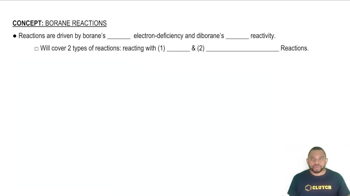
 01:18
01:18