Skip to main content
General Chemistry
My Course
Learn
Exam Prep
AI Tutor
Study Guides
Textbook Solutions
Flashcards
Explore
My Course
Learn
Exam Prep
AI Tutor
Study Guides
Textbook Solutions
Flashcards
Explore
Back
Bond Angles definitions
You can tap to flip the card.
Bond angle
You can tap to
flip the card.
👆
Bond angle
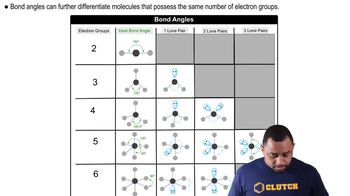
The angle between two bonds originating from the same central atom in a molecule.
Track progress
Control buttons has been changed to "navigation" mode.
1/15
Related practice
Recommended videos
Guided course
01:53
Bond Angles
Jules
Guided course
01:17
Ideal Bond Angle Example
Jules
Guided course
03:37
Bond Angles and Electron Groups
Jules
Terms in this set (15)
Hide definitions
Bond angle
The angle between two bonds originating from the same central atom in a molecule.
Central atom
An atom in a molecule from which bonds to surrounding atoms originate.
Lone pair
A pair of valence electrons not shared with another atom, affecting bond angles by increasing repulsion.
Ideal bond angle
The optimal angle between bonds that minimizes electron repulsion when no lone pairs are present.
Electron group
A set of electrons around a central atom, including bonds and lone pairs, influencing molecular shape.
Linear shape
A molecular shape with two electron groups and a bond angle of 180 degrees.
Trigonal planar
A molecular shape with three electron groups and a bond angle of 120 degrees.
Equatorial position
Positions around a central atom in a trigonal bipyramidal shape, typically with 120-degree bond angles.
Axial position
Positions in a trigonal bipyramidal shape, typically with 90-degree bond angles to equatorial positions.
Trigonal bipyramidal
A molecular shape with five electron groups, having both equatorial and axial bond angles.
Tetrahedral
A molecular shape with four electron groups and an ideal bond angle of 109.5 degrees.
Bent shape
A molecular shape resulting from lone pairs reducing bond angles from their ideal values.
Octahedral
A molecular shape with six electron groups, typically having 90-degree bond angles.
Repulsion
The force that pushes electron groups apart, affecting bond angles in a molecule.
Molecular geometry
The three-dimensional arrangement of atoms in a molecule, influenced by bond angles and lone pairs.
 Back
Back
 Back
Back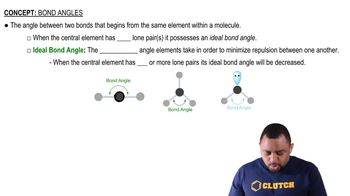
 01:53
01:53