Skip to main content
General Chemistry
My Course
Learn
Exam Prep
AI Tutor
Study Guides
Textbook Solutions
Flashcards
Explore
My Course
Learn
Exam Prep
AI Tutor
Study Guides
Textbook Solutions
Flashcards
Explore
Back
Bohr Model definitions
You can tap to flip the card.
Bohr Model
You can tap to
flip the card.
👆
Bohr Model
A model where electrons orbit the nucleus in defined paths called shells, each with a specific energy level.
Track progress
Control buttons has been changed to "navigation" mode.
1/15
Related flashcards
Related practice
Recommended videos
Guided course
02:43
Bohr Model of the Atom
Jules
Guided course
01:21
Bohr Model Example
Jules
Guided course
03:29
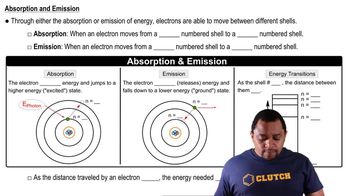
Electronic Transitions
Jules
Terms in this set (15)
Hide definitions
Bohr Model
A model where electrons orbit the nucleus in defined paths called shells, each with a specific energy level.
Shell
A grouping of electrons surrounding the nucleus, associated with a specific energy level denoted by n.
Principal Quantum Number
Denoted by n, it represents the shell number and energy level of an electron in an atom.
Rydberg Constant
A constant used in calculating the potential energy of an electron in a shell, valued at 2.178 x 10^-18 J.
Atomic Number
The number of protons in the nucleus of an atom, denoted by Z.
Potential Energy
The energy of position for an electron in a shell, calculated using the Rydberg formula.
Absorption
The process where an electron moves to a higher energy shell by absorbing energy.
Emission
The process where an electron releases energy and moves to a lower energy shell.
Ground State
The lowest energy state of an electron in an atom, typically the original shell.
Excited State
A higher energy state of an electron after absorbing energy and moving to a higher shell.
Energy Transition
The movement of an electron between shells, requiring energy proportional to the distance.
Photon
A particle representing a quantum of light, which can transfer energy to electrons.
Orbit
The path followed by electrons around the nucleus in the Bohr model.
Proton
A positively charged particle found in the nucleus of an atom.
Neutron
A neutrally charged particle found in the nucleus of an atom.
 Back
Back
 Back
Back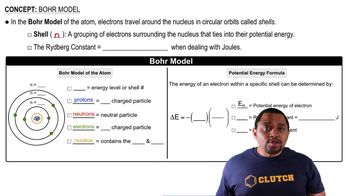
 02:43
02:43