Skip to main content
General Chemistry
My Course
Learn
Exam Prep
AI Tutor
Study Guides
Textbook Solutions
Flashcards
Explore
My Course
Learn
Exam Prep
AI Tutor
Study Guides
Textbook Solutions
Flashcards
Explore
Back
Band of Stability: Beta Decay definitions
You can tap to flip the card.
Beta Decay
You can tap to
flip the card.
👆
Beta Decay
A nuclear process where isotopes convert excess neutrons into protons to achieve stability.
Track progress
Control buttons has been changed to "navigation" mode.
1/10
Related practice
Recommended videos
Guided course
01:13
Band of Stability: Beta Decay
Jules
Guided course
01:11
Band of Stability: Beta Decay Example
Jules
Terms in this set (10)
Hide definitions
Beta Decay
A nuclear process where isotopes convert excess neutrons into protons to achieve stability.
Isotopes
Variants of elements with the same number of protons but different numbers of neutrons.
Band of Stability
A region on the nuclear chart where stable isotopes are found, balancing neutron-to-proton ratios.
Neutrons
Subatomic particles in an atom's nucleus with no electric charge, affecting isotopic stability.
Protons
Positively charged subatomic particles in an atom's nucleus, determining the element's identity.
Nuclear Chart
A graphical representation of isotopes showing their stability based on neutron and proton numbers.
Palladium-107
An isotope that undergoes beta decay to transform into silver-107 by emitting a beta particle.
Silver-107
The stable isotope formed from palladium-107 after beta decay, with a balanced neutron-to-proton ratio.
Beta Particle
A high-energy, high-speed electron or positron emitted during beta decay.
Neutron-to-Proton Ratio
A measure of an isotope's stability, influencing its position on the band of stability.
 Back
Back
 Back
Back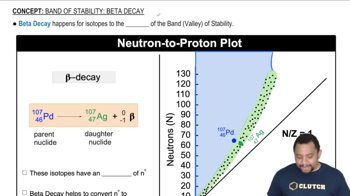
 01:13
01:13