Skip to main content
General Chemistry
My Course
Learn
Exam Prep
AI Tutor
Study Guides
Textbook Solutions
Flashcards
Explore
My Course
Learn
Exam Prep
AI Tutor
Study Guides
Textbook Solutions
Flashcards
Explore
Back
Atomic, Ionic, and Molecular Solids definitions
You can tap to flip the card.
Crystalline Solids
You can tap to
flip the card.
👆
Crystalline Solids
Solids with highly ordered arrangements of atoms, ions, or molecules.
Track progress
Control buttons has been changed to "navigation" mode.
1/15
Related practice
Recommended videos
Guided course
04:13
Crystalline vs Amorphous Solids
Jules
Guided course
00:34
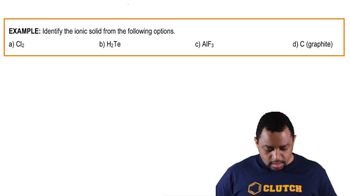
Ionic Solid Identification Example
Jules
Terms in this set (15)
Hide definitions
Crystalline Solids
Solids with highly ordered arrangements of atoms, ions, or molecules.
Amorphous Solids
Solids with randomly arranged particles and no discernible pattern.
Ionic Solids
Solids formed from cations and anions with high melting points and brittleness.
Molecular Solids
Solids composed of molecules bonded by intermolecular forces, generally soft.
Covalent Network Solids
Solids with atoms linked by covalent bonds, extremely hard with high melting points.
Metals
Solids with metallic bonds, ranging from soft to hard, often lustrous.
Polymers
Large molecules composed of repeating structural units, often found in plastics.
Electrostatic Forces
Forces of attraction between charged particles, crucial in ionic and molecular solids.
Intermolecular Forces
Forces between molecules affecting the properties of molecular solids.
Covalent Bonds
Strong bonds formed by sharing electrons between atoms, found in covalent networks.
Metallic Bonds
Bonds formed by the pooling of electrons among metal atoms.
Lustrous
Having a shiny appearance, a characteristic of many metals.
Melting Point
The temperature at which a solid becomes a liquid.
Graphite
A form of carbon with a layered structure, used in pencils.
Tar
A black, sticky substance used on roads, an example of an amorphous solid.
 Back
Back
 Back
Back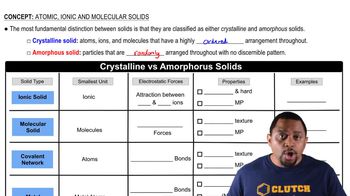
 04:13
04:13