Skip to main content
General Chemistry
My Course
Learn
Exam Prep
AI Tutor
Study Guides
Textbook Solutions
Flashcards
Explore
My Course
Learn
Exam Prep
AI Tutor
Study Guides
Textbook Solutions
Flashcards
Explore
Back
Atomic Radius & Density of Transition Metals definitions
You can tap to flip the card.
Atomic Radius
You can tap to
flip the card.
👆
Atomic Radius
The distance from the nucleus to the outermost electron shell, decreasing gradually across transition metals.
Track progress
Control buttons has been changed to "navigation" mode.
1/15
Related practice
Recommended videos
Guided course
02:45
Atomic Radius
Jules
Guided course
01:27
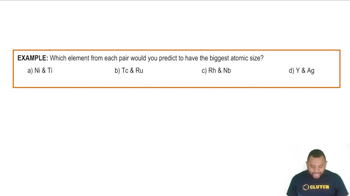
Atomic Radius and Density of Transition Metals Example
Jules
Guided course
02:30
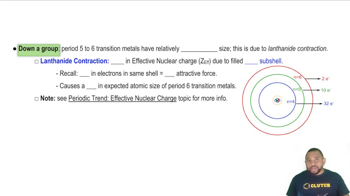
Lanthanide Contraction
Jules
Terms in this set (15)
Hide definitions
Atomic Radius
The distance from the nucleus to the outermost electron shell, decreasing gradually across transition metals.
Transition Metals
Elements in the d-block of the periodic table, known for gradual changes in atomic radius.
Lanthanide Contraction
A phenomenon where increased effective nuclear charge causes a decrease in atomic size in period 6 transition metals.
Effective Nuclear Charge
The net positive charge experienced by electrons, influencing atomic size and density.
S Orbitals
The outermost electron orbitals in transition metals, typically holding 1 or 2 electrons.
D Orbitals
Inner electron orbitals in transition metals, where additional electrons are added.
F Orbitals
Inner orbitals in periods 5 and 6, contributing to lanthanide contraction.
Density
A measure of mass per unit volume, increasing with mass in transition metals.
Period
A horizontal row in the periodic table, where atomic radius and density trends are observed.
Group
A vertical column in the periodic table, where density increases more significantly than across a period.
Principal Quantum Number
Denoted as n, it represents the shell number of an electron in an atom.
Krypton
A noble gas used as a reference in electron configurations of transition metals.
Xenon
A noble gas used in electron configurations, indicating filled inner shells.
Protons
Positively charged particles in the nucleus, contributing to effective nuclear charge.
Neutrons
Neutral particles in the nucleus, not affecting the atomic radius directly.
 Back
Back
 Back
Back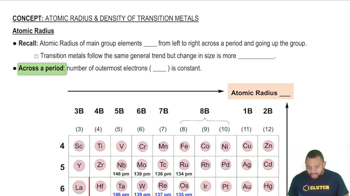
 02:45
02:45