Skip to main content
General Chemistry
My Course
Learn
Exam Prep
AI Tutor
Study Guides
Textbook Solutions
Flashcards
Explore
My Course
Learn
Exam Prep
AI Tutor
Study Guides
Textbook Solutions
Flashcards
Explore
Back
Atomic Mass definitions
You can tap to flip the card.
Atomic Mass
You can tap to
flip the card.
👆
Atomic Mass
Weighted average mass of an element's isotopes, reflecting protons, neutrons, and electrons.
Track progress
Control buttons has been changed to "navigation" mode.
1/12
Related flashcards
Related practice
Recommended videos
Guided course
02:19
Atomic Mass
Jules
Guided course
02:06
Greatest Atomic Mass Example
Jules
Guided course
02:00
Calculating Atomic Mass
Jules
Terms in this set (12)
Hide definitions
Atomic Mass
Weighted average mass of an element's isotopes, reflecting protons, neutrons, and electrons.
Isotopes
Variants of an element with different numbers of neutrons but the same number of protons.
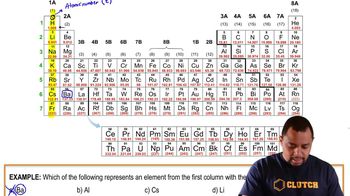
Periodic Table
A chart where elements are organized by atomic number, symbol, and atomic mass.
Atomic Mass Units
A unit of mass equal to 1.66 x 10^-27 kg, used to express atomic and molecular weights.
Daltons
Another term for atomic mass units, used in expressing atomic and molecular weights.
Atomic Number
The number of protons in the nucleus of an atom, denoted by the symbol Z.
Fractional Abundance
The percent abundance of an isotope divided by 100, used in atomic mass calculations.
Percent Abundance
The percentage of a particular isotope present in a natural sample of an element.
Natural Abundance
The relative proportion of different isotopes of an element as found in nature.
Element Symbol
A one or two-letter abbreviation for an element, found on the periodic table.
Subatomic Particles
Particles such as protons, neutrons, and electrons that make up an atom.
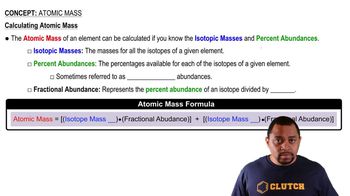
Atomic Mass Formula
A formula to calculate atomic mass using isotopic masses and fractional abundances.
 Back
Back
 Back
Back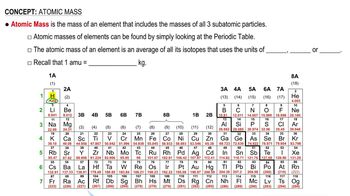
 02:19
02:19