Skip to main content
General Chemistry
My Course
Learn
Exam Prep
AI Tutor
Study Guides
Textbook Solutions
Flashcards
Explore
My Course
Learn
Exam Prep
AI Tutor
Study Guides
Textbook Solutions
Flashcards
Explore
Back
Arrhenius Equation definitions
You can tap to flip the card.
Arrhenius Equation
You can tap to
flip the card.
👆
Arrhenius Equation
Describes how temperature affects reaction rates, involving rate constant, frequency factor, activation energy, gas constant, and temperature.
Track progress
Control buttons has been changed to "navigation" mode.
1/10
Related practice
Recommended videos
Guided course
01:20
Arrhenius Equation
Jules
Guided course
02:36
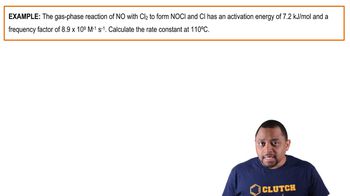
Rate Constant Calculation Example
Jules
Guided course
02:05
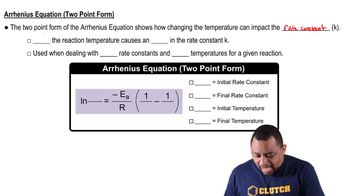
Arrhenius Equation Two-Point Form
Jules
Terms in this set (10)
Hide definitions
Arrhenius Equation
Describes how temperature affects reaction rates, involving rate constant, frequency factor, activation energy, gas constant, and temperature.
Rate Constant
A proportionality constant in the Arrhenius equation that changes with temperature, denoted as k.
Frequency Factor
Also known as the pre-exponential factor, it represents the frequency of collisions in the Arrhenius equation.
Activation Energy
The minimum energy required for a chemical reaction to occur, denoted as Ea in the Arrhenius equation.
Gas Constant
A constant used in the Arrhenius equation, valued at 8.314 J/(mol·K), denoted as R.
Temperature
A measure of thermal energy that influences the rate constant in the Arrhenius equation.
Two-Point Form
A form of the Arrhenius equation used to compare rate constants at two different temperatures.
Linear Form
A rearranged form of the Arrhenius equation used to determine activation energy from a plot of ln(k) vs. 1/T.
Natural Logarithm
The logarithm to the base e, used in the Arrhenius equation to express the exponential factor.
Inverse Temperature
The reciprocal of temperature, used as the x-axis in the linear form of the Arrhenius equation.
 Back
Back
 Back
Back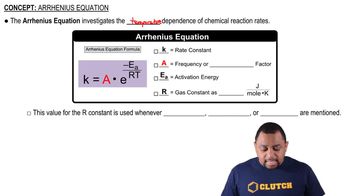
 01:20
01:20