Skip to main content
General Chemistry
My Course
Learn
Exam Prep
AI Tutor
Study Guides
Textbook Solutions
Flashcards
Explore
My Course
Learn
Exam Prep
AI Tutor
Study Guides
Textbook Solutions
Flashcards
Explore
Back
Arrhenius Acids and Bases definitions
You can tap to flip the card.
Arrhenius Acid
You can tap to
flip the card.
👆
Arrhenius Acid
A compound that releases H+ ions when dissolved in water, exemplified by hydrobromic acid.
Track progress
Control buttons has been changed to "navigation" mode.
1/10
Related practice
Recommended videos
Guided course
02:00
Arrhenius Acids and Bases
Jules
Guided course
00:54
Acid-Base Dissociation Example
Jules
Terms in this set (10)
Hide definitions
Arrhenius Acid
A compound that releases H+ ions when dissolved in water, exemplified by hydrobromic acid.
Arrhenius Base
A compound that releases OH- ions when dissolved in water, exemplified by potassium hydroxide.
Hydrobromic Acid
An example of an Arrhenius acid that dissociates in water to produce H+ ions.
Potassium Hydroxide
An example of an Arrhenius base that dissociates in water to produce OH- ions.
Aqueous Solution
A solution in which the solvent is water, crucial for Arrhenius acid-base reactions.
H+ Ion
A hydrogen ion released by Arrhenius acids in aqueous solutions.
OH- Ion
A hydroxide ion released by Arrhenius bases in aqueous solutions.
Potassium Ion
A K+ ion produced when potassium hydroxide dissolves in water.
Limitations
The Arrhenius definition is restricted to reactions in aqueous solutions.
Swedish Chemist
Asvante Arrhenius, who proposed the initial definitions of acids and bases.
 Back
Back
 Back
Back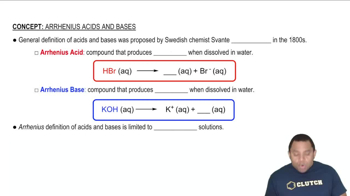
 02:00
02:00