Skip to main content
General Chemistry
My Course
Learn
Exam Prep
AI Tutor
Study Guides
Textbook Solutions
Flashcards
Explore
My Course
Learn
Exam Prep
AI Tutor
Study Guides
Textbook Solutions
Flashcards
Explore
Back
Amide Formation definitions
You can tap to flip the card.
Amide
You can tap to
flip the card.
👆
Amide
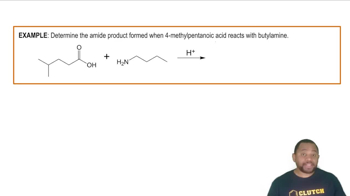
A compound featuring a carbonyl group single-bonded to a nitrogen atom.
Track progress
Control buttons has been changed to "navigation" mode.
1/11
Related practice
Recommended videos
Guided course
01:41
Amide Formation
Jules
Guided course
00:48
Amide Formation Example
Jules
Terms in this set (11)
Hide definitions
Amide
A compound featuring a carbonyl group single-bonded to a nitrogen atom.
Condensation Reaction
A chemical process where two molecules combine, resulting in the loss of water.
Carboxylic Acid
An organic acid containing a carboxyl group, often participating in amide formation.
Amine
An organic compound derived from ammonia, containing a nitrogen atom bonded to hydrogen atoms.
Hydroxyl Group
A functional group consisting of an oxygen atom bonded to a hydrogen atom, represented as OH.
Catalyst
A substance that increases the rate of a chemical reaction without being consumed.
Carbonyl Group
A functional group composed of a carbon atom double-bonded to an oxygen atom, represented as C=O.
Nitrogen
A chemical element with the symbol N, essential in forming amides.
Hydrogen
A chemical element with the symbol H, often involved in forming water during reactions.
Water
A molecule formed by the combination of two hydrogen atoms and one oxygen atom, often a byproduct in reactions.
H+
A proton, often acting as a catalyst in chemical reactions like amide formation.
 Back
Back
 Back
Back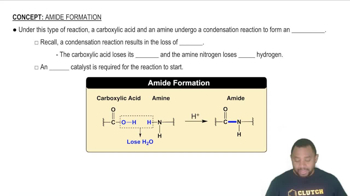
 01:41
01:41