Skip to main content
General Chemistry
My Course
Learn
Exam Prep
AI Tutor
Study Guides
Textbook Solutions
Flashcards
Explore
My Course
Learn
Exam Prep
AI Tutor
Study Guides
Textbook Solutions
Flashcards
Explore
Back
Alpha Decay definitions
You can tap to flip the card.
Alpha particle
You can tap to
flip the card.
👆
Alpha particle
Consists of 2 protons and 2 neutrons, equivalent to a helium-4 nucleus, emitted during alpha decay.
Track progress
Control buttons has been changed to "navigation" mode.
1/13
Related practice
Recommended videos
Guided course
03:53
Alpha Decay
Jules
Guided course
01:22
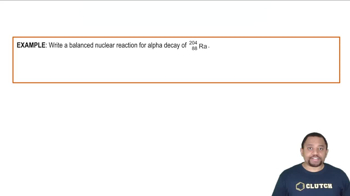
Alpha Decay Reaction Example
Jules
Guided course
02:48
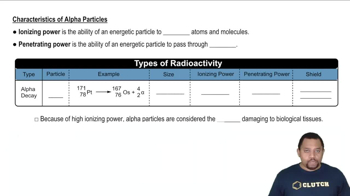
Characteristics of Alpha Particles
Jules
Terms in this set (13)
Hide definitions
Alpha particle
Consists of 2 protons and 2 neutrons, equivalent to a helium-4 nucleus, emitted during alpha decay.
Helium-4
An isotope of helium with 2 protons and 2 neutrons, identical to an alpha particle.
Mass number
The total number of protons and neutrons in a nucleus, crucial for balancing nuclear reactions.
Atomic number
The number of protons in a nucleus, unique to each element, used in balancing nuclear reactions.
Heavy nuclei
Nuclei with excess protons and neutrons, often undergoing alpha decay to achieve stability.
Ionizing power
The ability of a particle to ionize atoms and molecules, high in alpha particles.
Penetrating power
The ability of a particle to pass through matter, low in alpha particles due to their size.
Osmium
A dense element with atomic number 76, produced from platinum-171 during alpha decay.
Platinum-171
An isotope that undergoes alpha decay to form osmium-167 and an alpha particle.
Radioactivity
The process by which unstable nuclei emit particles, such as alpha particles, to become stable.
Nuclear reaction
A process involving changes in an atom's nucleus, requiring balanced mass and atomic numbers.
Biological tissues
Body tissues that can be damaged by ionizing radiation, particularly from alpha particles.
Protective measures
Methods like clothing and paper that shield against alpha particles due to their low penetrating power.
 Back
Back
 Back
Back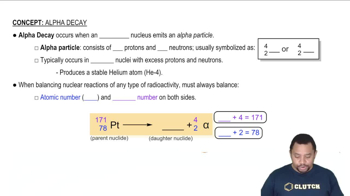
 03:53
03:53