Skip to main content
General Chemistry
My Course
Learn
Exam Prep
AI Tutor
Study Guides
Textbook Solutions
Flashcards
Explore
My Course
Learn
Exam Prep
AI Tutor
Study Guides
Textbook Solutions
Flashcards
Explore
Back
Alkane Reactions definitions
You can tap to flip the card.
Alkanes
You can tap to
flip the card.
👆
Alkanes
The least reactive hydrocarbons, primarily undergoing combustion and halogenation reactions.
Track progress
Control buttons has been changed to "navigation" mode.
1/15
Related practice
Recommended videos
Guided course
02:25
Common Types of Alkane Reactions
Jules
Guided course
02:15
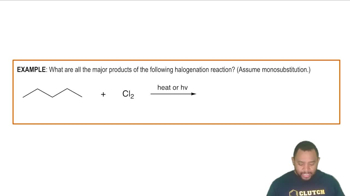
Alkane Reactions Example
Jules
Terms in this set (15)
Hide definitions
Alkanes
The least reactive hydrocarbons, primarily undergoing combustion and halogenation reactions.
Hydrocarbons
Compounds composed of only carbon and hydrogen atoms.
Combustion
A reaction where a hydrocarbon reacts with oxygen to produce carbon dioxide and water.
Halogenation
A substitution reaction where a halogen replaces a hydrogen atom in an alkane.
Alkyl Halides
Compounds formed when a halogen atom replaces a hydrogen atom in an alkane.
Methane
The simplest alkane, often used in halogenation reactions as a starting material.
Bromine
A halogen that can replace hydrogen in alkanes during halogenation.
Chlorine
A halogen used in halogenation to substitute hydrogen atoms in alkanes.
Ultraviolet Light
Energy form represented as HV, used to break halogen bonds in halogenation.
Mono Substitution
A reaction where only one hydrogen atom in an alkane is replaced by a halogen.
Poly Substitution
A reaction where more than one hydrogen atom in an alkane is replaced by halogens.
Carbon Dioxide
A product of alkane combustion, formed alongside water.
Water
A product of alkane combustion, formed alongside carbon dioxide.
Heat
Energy required to initiate halogenation reactions in alkanes.
Substitution Reaction
A chemical reaction where an atom in a molecule is replaced by another atom.
 Back
Back
 Back
Back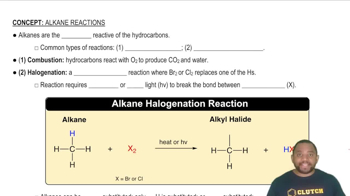
 02:25
02:25