Skip to main content
General Chemistry
My Course
Learn
Exam Prep
AI Tutor
Study Guides
Textbook Solutions
Flashcards
Explore
My Course
Learn
Exam Prep
AI Tutor
Study Guides
Textbook Solutions
Flashcards
Explore
Back
Aldehydes and Ketones Reactions definitions
You can tap to flip the card.
Reduction
You can tap to
flip the card.
👆
Reduction
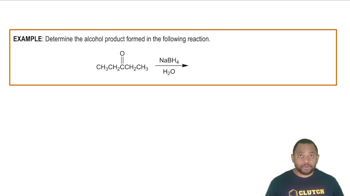
A chemical reaction where aldehydes or ketones gain hydrogen atoms, converting them into alcohols.
Track progress
Control buttons has been changed to "navigation" mode.
1/14
Related practice
Recommended videos
Guided course
01:50
Aldehyde and Ketone Reactions
Jules
Guided course
00:50
Aldehyde and Ketone Reactions Example
Jules
Terms in this set (14)
Hide definitions
Reduction
A chemical reaction where aldehydes or ketones gain hydrogen atoms, converting them into alcohols.
Sodium Borohydride
A reducing agent, NaBH4, used to add hydrogen atoms to carbonyl compounds, forming alcohols.
Aldehydes
Organic compounds containing a carbonyl group bonded to at least one hydrogen atom.
Ketones
Organic compounds with a carbonyl group bonded to two carbon atoms.
Alcohols
Organic compounds where a hydroxyl group is bonded to a saturated carbon atom.
Carbonyl Group
A functional group composed of a carbon atom double-bonded to an oxygen atom.
Hydrogen Atom
The simplest atom, consisting of one proton and one electron, added during reduction.
Carbon-Hydrogen Bond
A covalent bond between carbon and hydrogen, increased during reduction reactions.
Pi Bond
A type of covalent bond formed by the sideways overlap of atomic orbitals, lost during reduction.
Carbonyl Carbon
The carbon atom in a carbonyl group, which gains hydrogen during reduction.
Carbonyl Oxygen
The oxygen atom in a carbonyl group, which gains hydrogen during reduction.
Carboxylic Acid
An organic acid containing a carboxyl group, not involved in the discussed reduction.
Hydrocarbon
Compounds composed entirely of hydrogen and carbon, not directly involved in reduction.
Genchem
A shorthand term for general chemistry, where basic reduction concepts are introduced.
 Back
Back
 Back
Back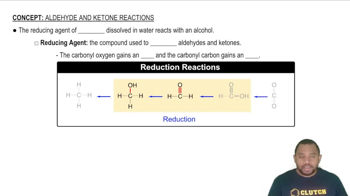
 01:50
01:50