Skip to main content
General Chemistry
My Course
Learn
Exam Prep
AI Tutor
Study Guides
Textbook Solutions
Flashcards
Explore
My Course
Learn
Exam Prep
AI Tutor
Study Guides
Textbook Solutions
Flashcards
Explore
Back
Alcohol Reactions: Substitution Reactions definitions
You can tap to flip the card.
Alcohol
You can tap to
flip the card.
👆
Alcohol
An organic compound with a hydroxyl group (-OH) attached to a carbon atom.
Track progress
Control buttons has been changed to "navigation" mode.
1/11
Related practice
Recommended videos
Guided course
01:08
Alcohol Reactions: Substitution Reactions
Jules
Guided course
00:41
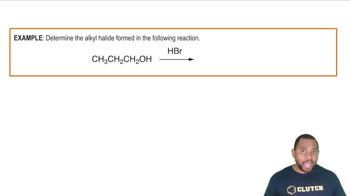
Alcohol Reactions Substitution Reactions Example
Jules
Terms in this set (11)
Hide definitions
Alcohol
An organic compound with a hydroxyl group (-OH) attached to a carbon atom.
Alkyl Halide
A compound where a halogen atom replaces a hydroxyl group in an alcohol.
Substitution Reaction
A chemical reaction where an atom or group in a molecule is replaced by another atom or group.
Hydrochloric Acid
A strong acid used to convert alcohols into alkyl chlorides by replacing the hydroxyl group with chlorine.
Hydrobromic Acid
A strong acid used to convert alcohols into alkyl bromides by replacing the hydroxyl group with bromine.
Hydroxyl Group
A functional group consisting of an oxygen atom bonded to a hydrogen atom (-OH).
Halogen
A group of elements including chlorine and bromine, used in substitution reactions with alcohols.
Chlorine
A halogen element that can replace the hydroxyl group in alcohols to form alkyl chlorides.
Bromine
A halogen element that can replace the hydroxyl group in alcohols to form alkyl bromides.
Functional Group
A specific group of atoms within a molecule responsible for characteristic reactions of that molecule.
Carbon
An element that forms the backbone of organic molecules, bonding with hydroxyl groups in alcohols.
 Back
Back
 Back
Back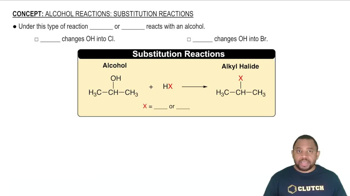
 01:08
01:08