Use line notation to represent each electrochemical cell described in Problem 44.
Verified step by step guidance
1
Identify the components of the electrochemical cell, including the anode, cathode, and the solutions they are in contact with.
Determine the oxidation and reduction half-reactions occurring at the anode and cathode, respectively.
Write the line notation starting with the anode (where oxidation occurs) on the left and the cathode (where reduction occurs) on the right.
Separate different phases within each half-cell with a single vertical line (|) and separate the anode and cathode compartments with a double vertical line (||), which represents the salt bridge or porous barrier.
Ensure that the line notation reflects the correct order of components: anode material | anode solution || cathode solution | cathode material.
Key Concepts
Here are the essential concepts you must grasp in order to answer the question correctly.
Electrochemical Cells
Electrochemical cells are devices that convert chemical energy into electrical energy through redox reactions. They consist of two electrodes, an anode where oxidation occurs, and a cathode where reduction takes place. Understanding the function and components of these cells is essential for representing them accurately in line notation.
Line notation is a standardized way to represent electrochemical cells, providing a clear and concise format for describing the components and reactions occurring within the cell. It typically includes the anode and cathode materials, the phases of the reactants and products, and the electrolyte, separated by vertical lines to indicate the different phases.
Oxidation and reduction are fundamental concepts in electrochemistry, representing the loss and gain of electrons, respectively. In an electrochemical cell, the anode undergoes oxidation (loses electrons), while the cathode undergoes reduction (gains electrons). Understanding these processes is crucial for accurately depicting the reactions in line notation.


 Verified step by step guidance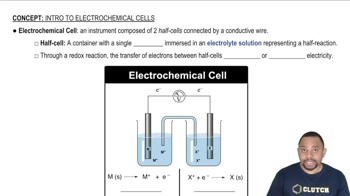
 02:46
02:46