
Textbook Question
Using Figures 9.39 and 9.43 as guides, draw the molecular-orbital electron configuration for (d) Ne22+. In each case indicate whether the addition of an electron to the ion would increase or decrease the bond order of the species.



 Verified step by step guidance
 00:36
00:36
 00:59
00:59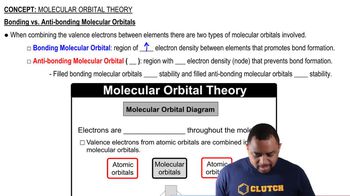 03:06
03:06Using Figures 9.39 and 9.43 as guides, draw the molecular-orbital electron configuration for (d) Ne22+. In each case indicate whether the addition of an electron to the ion would increase or decrease the bond order of the species.
Determine whether each of the following statements about diamagnetism and paramagnetism is true or false:
a. A diamagnetic substance is weakly repelled from a magnetic field.
b. A substance with unpaired electrons will be diamagnetic.
c. A paramagnetic substance is attracted to a magnetic field.
d. The O2 molecule is paramagnetic.
a. Which of the following is expected to be paramagnetic: Ne, Li2, Li2+, N2, N2+, N22−? b. For each of the substances in part (a) that is paramagnetic, determine the number of unpaired electrons it has.
If we assume that the energy-level diagrams for homonuclear diatomic molecules shown in Figure 9.43 can be applied to heteronuclear diatomic molecules and ions, predict the bond order and magnetic behavior of d. NeF+
Determine the electron configurations for CN+, CN, and CN-. (a) Which species has the strongest C¬N bond?
Determine the electron configurations for CN+, CN, and CN-. b. Which species, if any, is paramagnetic?