Table of contents
- 0. Functions(0)
- Introduction to Functions(0)
- Piecewise Functions(0)
- Properties of Functions(0)
- Common Functions(0)
- Transformations(0)
- Combining Functions(0)
- Exponent rules(0)
- Exponential Functions(0)
- Logarithmic Functions(0)
- Properties of Logarithms(0)
- Exponential & Logarithmic Equations(0)
- Introduction to Trigonometric Functions(0)
- Graphs of Trigonometric Functions(0)
- Trigonometric Identities(0)
- Inverse Trigonometric Functions(0)
- 1. Limits and Continuity(0)
- 2. Intro to Derivatives(0)
- 3. Techniques of Differentiation(0)
- 4. Applications of Derivatives(0)
- 5. Graphical Applications of Derivatives(0)
- 6. Derivatives of Inverse, Exponential, & Logarithmic Functions(0)
- 7. Antiderivatives & Indefinite Integrals(0)
- 8. Definite Integrals(0)
- 9. Graphical Applications of Integrals(0)
- 10. Physics Applications of Integrals (0)
- 11. Integrals of Inverse, Exponential, & Logarithmic Functions(0)
- 12. Techniques of Integration(0)
- 13. Intro to Differential Equations(0)
- 14. Sequences & Series(0)
- 15. Power Series(0)
- 16. Parametric Equations & Polar Coordinates(0)
4. Applications of Derivatives
Motion Analysis
4. Applications of Derivatives
Motion Analysis: Videos & Practice Problems
52 of 0
Problem 52Multiple Choice
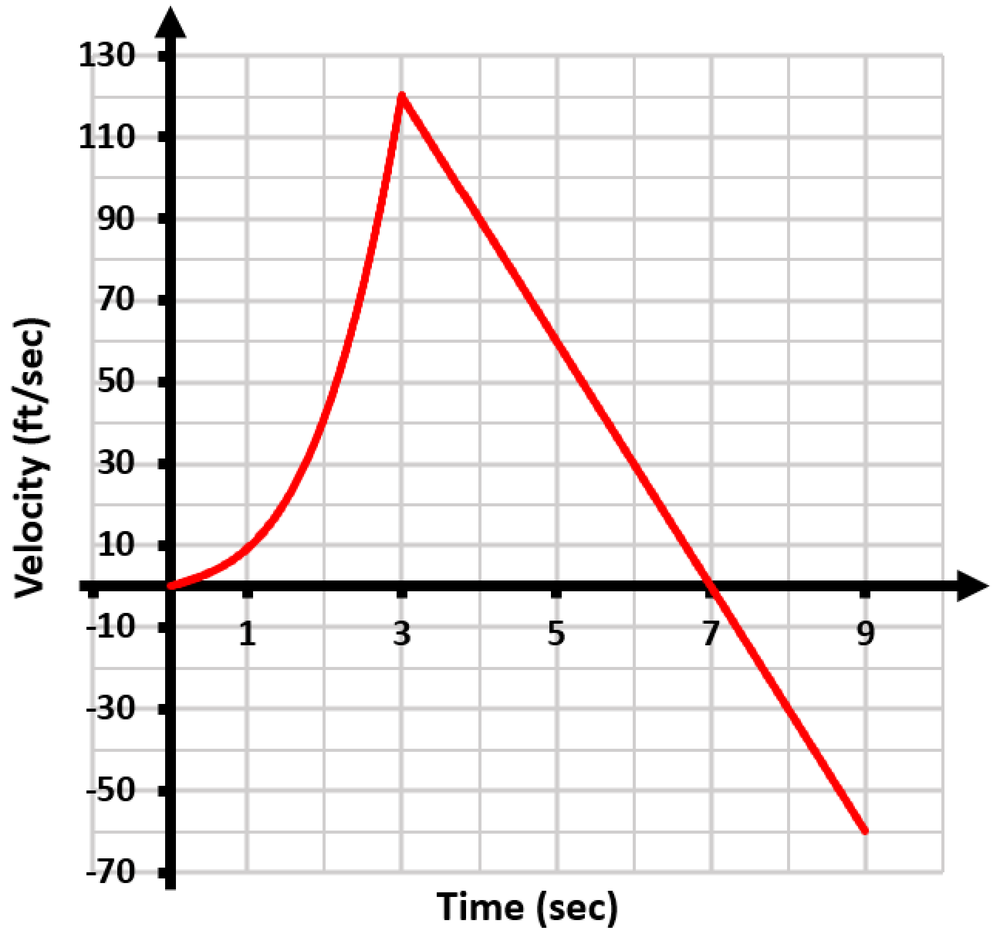
A student is conducting an experiment with a water rocket. The rocket is launched vertically up, and its velocity is tracked using a sensor. The expulsion of water accelerates it upward. When the water is fully expelled, the rocket briefly continues to ascend and then starts to fall. As the rocket descends, it accidentally hits a tree, which makes the sensor stop. The graph shows the velocity of the water rocket during its flight.
When did the rocket attain its maximum acceleration?

0 Comments