Evaluate the limit of the factored expression: \( \lim_{x \to \infty} x^{12} \) and \( \lim_{x \to \infty} (3 - 9x^{-5}) \).
Since \( x^{12} \to \infty \) and \( 3 - 9x^{-5} \to 3 \), the overall limit is determined by the behavior of x^{12}.
Verified video answer for a similar problem:
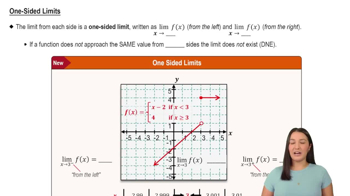
This video solution was recommended by our tutors as helpful for the problem above
Video duration:
2m
Play a video:
Was this helpful?
Key Concepts
Here are the essential concepts you must grasp in order to answer the question correctly.
Limits at Infinity
Limits at infinity involve evaluating the behavior of a function as the input approaches infinity. This concept is crucial for understanding how functions behave for very large values of x, particularly in polynomial functions where the highest degree term often dominates the behavior of the function.
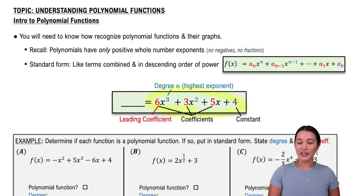
Polynomial functions are expressions that consist of variables raised to non-negative integer powers, combined using addition, subtraction, and multiplication. In the context of limits, the degree of the polynomial plays a significant role in determining the limit as x approaches infinity, as the term with the highest degree will have the greatest impact on the function's value.
The dominant term in a polynomial is the term with the highest degree, which significantly influences the value of the polynomial as x becomes very large. When calculating limits at infinity, identifying the dominant term allows for simplification, as lower degree terms become negligible compared to the dominant term.