b. Smallest slope What is the smallest slope on the curve? At what point on the curve does the curve have this slope?
Verified step by step guidance
1
To find the smallest slope on the curve, we need to determine the derivative of the function that defines the curve. The derivative represents the slope of the tangent line at any point on the curve.
Once we have the derivative, we need to find the critical points by setting the derivative equal to zero and solving for the variable. These points are where the slope could potentially be at a minimum or maximum.
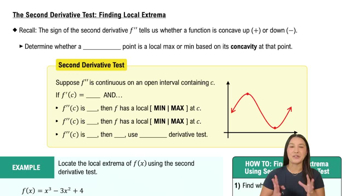
After finding the critical points, we should evaluate the second derivative to determine the concavity of the function at these points. This will help us identify whether each critical point is a minimum, maximum, or a point of inflection.
The smallest slope will occur at the critical point where the second derivative is positive, indicating a local minimum. Evaluate the first derivative at this point to find the slope.
Finally, substitute the critical point back into the original function to find the corresponding point on the curve where this smallest slope occurs.
Verified video answer for a similar problem:
This video solution was recommended by our tutors as helpful for the problem above
Video duration:
3m
Play a video:
0 Comments
Key Concepts
Here are the essential concepts you must grasp in order to answer the question correctly.
Derivative
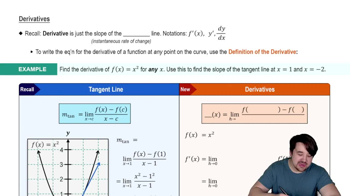
The derivative of a function at a point provides the slope of the tangent line to the curve at that point. It is a fundamental tool in calculus for understanding how a function changes. To find the smallest slope on a curve, one must first determine the derivative of the function representing the curve.
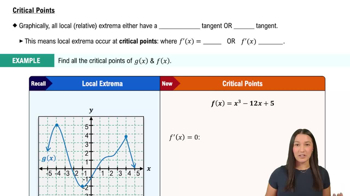
Critical points occur where the derivative of a function is zero or undefined. These points are potential candidates for local minima, maxima, or points of inflection. To find the smallest slope, identify the critical points by setting the derivative equal to zero and solving for the variable.
The second derivative test helps determine the nature of critical points found from the first derivative. If the second derivative at a critical point is positive, the function has a local minimum there. This test is useful for confirming that a critical point corresponds to the smallest slope on the curve.

 3:50 minutes
 Verified step by step guidance
 05:44
05:44