Let f(x) = x2 - 6x + 5. Find the values of x for which the slope of the curve y = f(x) is 0.
Verified step by step guidance
1
Step 1: To find the values of x for which the slope of the curve y = f(x) is 0, we need to find the derivative of f(x) with respect to x. The derivative, f'(x), represents the slope of the curve at any point x.
Step 2: Differentiate f(x) = x^2 - 6x + 5. Using the power rule, the derivative of x^2 is 2x, and the derivative of -6x is -6. The derivative of a constant, 5, is 0.
Step 3: Combine the derivatives to get f'(x) = 2x - 6.
Step 4: Set the derivative equal to 0 to find the x-values where the slope is 0. So, solve the equation 2x - 6 = 0.
Step 5: Solve for x by adding 6 to both sides and then dividing by 2. This will give you the x-value(s) where the slope of the curve is 0.
Verified video answer for a similar problem:
This video solution was recommended by our tutors as helpful for the problem above
Video duration:
2m
Play a video:
0 Comments
Key Concepts
Here are the essential concepts you must grasp in order to answer the question correctly.
Derivative
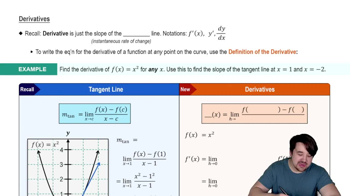
The derivative of a function measures the rate at which the function's value changes as its input changes. It is a fundamental concept in calculus that provides information about the slope of the tangent line to the curve at any given point. For the function f(x), finding the derivative f'(x) will allow us to determine where the slope of the curve is zero.
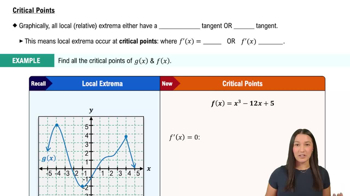
Critical points occur where the derivative of a function is either zero or undefined. These points are significant because they can indicate local maxima, minima, or points of inflection on the graph of the function. In this problem, we will find the critical points by setting the derivative of f(x) equal to zero to identify where the slope of the curve is flat.
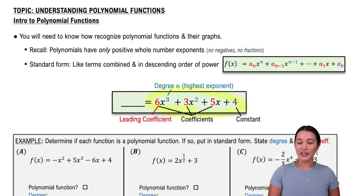
A quadratic function is a polynomial function of degree two, typically expressed in the form f(x) = ax^2 + bx + c. The graph of a quadratic function is a parabola, which can open upwards or downwards depending on the sign of the coefficient 'a'. Understanding the properties of quadratic functions, including their vertex and axis of symmetry, is essential for analyzing the behavior of f(x) in this problem.