Find all functions whose derivative is f'(x) = x + 1.
Verified step by step guidance
1
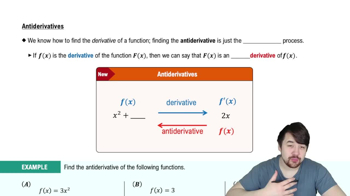
Start by understanding that the problem is asking for a function whose derivative is given. This means we need to find the antiderivative or integral of the function f'(x) = x + 1.
Recall that the antiderivative of a function f'(x) is a function F(x) such that F'(x) = f'(x). Therefore, we need to integrate f'(x) = x + 1 with respect to x.
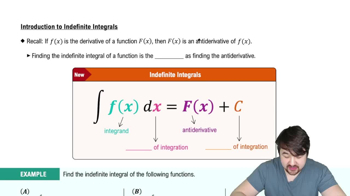
To integrate f'(x) = x + 1, apply the basic rules of integration: the integral of x with respect to x is (1/2)x^2, and the integral of 1 with respect to x is x.
Combine the results from the integration: the antiderivative of x + 1 is (1/2)x^2 + x. Remember to add the constant of integration, C, because the derivative of a constant is zero, and it could be any real number.
Thus, the general solution for the function whose derivative is f'(x) = x + 1 is F(x) = (1/2)x^2 + x + C, where C is an arbitrary constant.
Verified video answer for a similar problem:
This video solution was recommended by our tutors as helpful for the problem above
Video duration:
2m
Play a video:
0 Comments
Key Concepts
Here are the essential concepts you must grasp in order to answer the question correctly.
Derivative
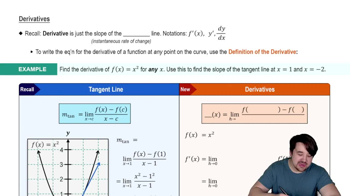
The derivative of a function measures how the function's output value changes as its input value changes. It represents the slope of the tangent line to the function's graph at any given point. Understanding derivatives is crucial for solving problems related to rates of change and for finding functions from their derivatives.
An antiderivative of a function is another function whose derivative is the original function. In this context, finding all functions whose derivative is f'(x) = x + 1 involves determining the antiderivative of that expression. The general form of an antiderivative includes a constant of integration, reflecting the fact that there are infinitely many functions that can share the same derivative.
Integration is the process of finding the antiderivative of a function. It is a fundamental concept in calculus that allows us to compute areas under curves and solve differential equations. In this case, integrating the function f'(x) = x + 1 will yield the original function f(x), along with a constant term that accounts for all possible vertical shifts of the function.


 2:09 minutes
 Verified step by step guidance
 05:44
05:44