Use definition (2) (p. 135) to find the slope of the line tangent to the graph of f at P. f(x) = √(x + 3); P (1,2)
Verified step by step guidance
1
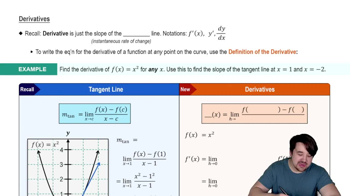
Step 1: Recall the definition of the derivative as the slope of the tangent line at a point. The derivative of a function f at a point x = a is given by the limit: \( f'(a) = \lim_{h \to 0} \frac{f(a+h) - f(a)}{h} \).
Step 2: Identify the function and the point of tangency. Here, the function is \( f(x) = \sqrt{x + 3} \) and the point P is (1, 2).
Step 3: Substitute the point of tangency into the derivative definition. We need to find \( f'(1) \), so substitute \( a = 1 \) into the limit: \( f'(1) = \lim_{h \to 0} \frac{\sqrt{1+h+3} - \sqrt{1+3}}{h} \).
Step 4: Simplify the expression inside the limit. This becomes \( \lim_{h \to 0} \frac{\sqrt{h+4} - 2}{h} \). To simplify further, multiply the numerator and the denominator by the conjugate of the numerator: \( \frac{\sqrt{h+4} - 2}{h} \times \frac{\sqrt{h+4} + 2}{\sqrt{h+4} + 2} \).
Step 5: Simplify the resulting expression. The numerator becomes \( (\sqrt{h+4})^2 - 2^2 = h + 4 - 4 = h \), so the expression simplifies to \( \lim_{h \to 0} \frac{h}{h(\sqrt{h+4} + 2)} \). Cancel \( h \) in the numerator and denominator, and evaluate the limit as \( h \to 0 \).
Verified video answer for a similar problem:
This video solution was recommended by our tutors as helpful for the problem above
Video duration:
4m
Play a video:
0 Comments
Key Concepts
Here are the essential concepts you must grasp in order to answer the question correctly.
Tangent Line
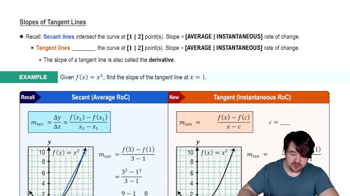
A tangent line to a curve at a given point is a straight line that touches the curve at that point without crossing it. The slope of the tangent line represents the instantaneous rate of change of the function at that point, which is crucial for understanding how the function behaves locally.
The derivative of a function at a point quantifies how the function's output changes as its input changes. It is defined as the limit of the average rate of change of the function as the interval approaches zero. In this context, finding the derivative of f(x) = √(x + 3) will provide the slope of the tangent line at point P.
The limit definition of the derivative states that the derivative f'(a) at a point a is the limit of the difference quotient as h approaches zero: f'(a) = lim(h→0) [(f(a + h) - f(a)) / h]. This definition is fundamental for calculating the slope of the tangent line using the function's values around the point of interest.

 4:17 minutes
 Verified step by step guidance
 05:13
05:13