Pearson+ LogoPearson+ Logo
Ch. 55 - Ecosystems and Restoration Ecology
Campbell - Campbell Biology 11th Edition
Urry11th EditionCampbell BiologyISBN: 9789357423311Not the one you use?Change textbook
Chapter 55, Problem 6

The Hubbard Brook watershed deforestation experiment yielded all of the following results except which of the following?
a. Most minerals were recycled within a forest ecosystem.
b. Calcium levels remained high in the soil of deforested areas.
c. Deforestation increased water runoff.
d. The nitrate concentration in waters draining the deforested area became dangerously high.

Verified step by step guidance
1
Understand the context of the Hubbard Brook watershed deforestation experiment, which studied the effects of deforestation on nutrient cycling and water runoff in a forest ecosystem.
Review the typical results of deforestation experiments: increased water runoff due to lack of vegetation, changes in soil nutrient levels, and alterations in mineral recycling within the ecosystem.
Analyze each option given in the problem: a) Most minerals were recycled within a forest ecosystem, b) Calcium levels remained high in the soil of deforested areas, c) Deforestation increased water runoff, d) The nitrate concentration in waters draining the deforested area became dangerously high.
Consider the impact of deforestation on soil nutrients. Typically, deforestation leads to a decrease in soil nutrient levels, including calcium, due to increased erosion and runoff.
Identify the statement that does not align with the expected results of deforestation, focusing on the nutrient levels in the soil and water runoff changes.

Verified video answer for a similar problem:

This video solution was recommended by our tutors as helpful for the problem above.
Video duration:
2m
Was this helpful?

Key Concepts

Here are the essential concepts you must grasp in order to answer the question correctly.

Nutrient Cycling in Forest Ecosystems

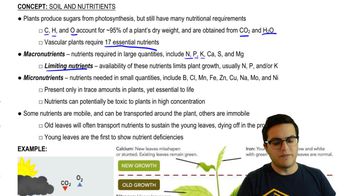
Nutrient cycling refers to the movement and exchange of organic and inorganic matter back into the production of living matter. In forest ecosystems, nutrients like nitrogen, phosphorus, and calcium are recycled through processes such as decomposition and uptake by plants. This recycling is crucial for maintaining soil fertility and ecosystem stability.
Recommended video:
Guided course
03:25
Soil Nutrients

Effects of Deforestation on Soil and Water

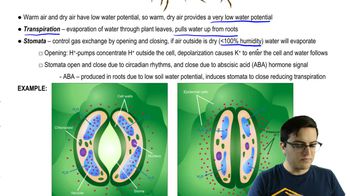
Deforestation can significantly impact soil and water systems. It often leads to increased water runoff due to the loss of vegetation that would normally absorb rainfall. This can result in soil erosion and the leaching of nutrients, altering the chemical composition of both soil and nearby water bodies, potentially increasing nutrient concentrations like nitrates in water.
Recommended video:
Guided course
08:29
Water Potential in Soil and Air

Calcium Dynamics in Soil

Calcium is an essential nutrient for plant growth, and its availability in soil is influenced by factors such as weathering of rocks, organic matter decomposition, and human activities like deforestation. In deforested areas, calcium levels can be affected by increased leaching due to higher water runoff, which may lead to a decrease in soil calcium content over time.
Recommended video:
Guided course
03:01
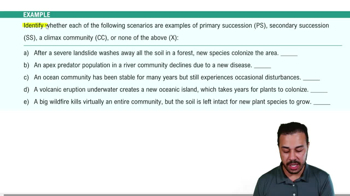
Community Dynamics Example 1
Related Practice
Textbook Question

The discipline that applies ecological principles to returning degraded ecosystems to a more natural state is known as

a. Restoration ecology

b. Thermodynamics

c. Eutrophication

d. Biogeochemistry

Textbook Question

Nitrifying bacteria participate in the nitrogen cycle mainly by

a. Converting nitrogen gas to ammonia

b. Releasing ammonium from organic compounds, thus returning it to the soil

c. Converting ammonium to nitrate, which plants absorb

d. Incorporating nitrogen into amino acids and organic compounds

Textbook Question

Which of the following has the greatest effect on the rate of chemical cycling in an ecosystem?

a. The rate of decomposition in the ecosystem

b. The production efficiency of the ecosystem's consumers

c. The trophic efficiency of the ecosystem

d. The location of the nutrient reservoirs in the ecosystem

Textbook Question

Which of the following would be considered an example of bioremediation?

a. Adding nitrogen-fixing microorganisms to a degraded ecosystem to increase nitrogen availability

b. Using a bulldozer to regrade a strip mine

c. Reconfiguring the channel of a river

d. Adding seeds of a chromium-accumulating plant to soil contaminated by chromium

Textbook Question

If you applied a fungicide to a cornfield, what would you expect to happen to the rate of decomposition and net ecosystem production (NEP)?

a. Both decomposition rate and NEP would decrease.

b. Neither would change.

c. Decomposition rate would increase and NEP would decrease.

d. Decomposition rate would decrease and NEP would increase.