

Pearson+ LogoPearson+ Logo
Ch. 53 - Population Ecology
Campbell - Campbell Biology 11th Edition
Urry11th EditionCampbell BiologyISBN: 9789357423311Not the one you use?Change textbook
Chapter 53, Problem 9

Which of the following statements about human populations in industrialized countries is incorrect?
a. Birth rates and death rates are high.
b. Average family size is relatively small.
c. The population has undergone the demographic transition.
d. The survivorship curve is Type I.

Verified step by step guidance
1
Understand the characteristics of human populations in industrialized countries. These populations typically have undergone demographic transitions, which affect birth and death rates, family size, and survivorship curves.
Review the concept of demographic transition. This is a model that describes population changes over time, typically moving from high birth and death rates to lower birth and death rates as a country becomes industrialized.
Examine the typical birth and death rates in industrialized countries. These countries usually have low birth and death rates due to better healthcare, education, and economic conditions.
Consider the average family size in industrialized countries. It is generally smaller due to factors such as increased access to contraception, higher education levels, and economic considerations.
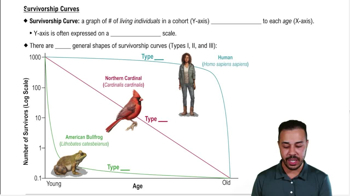
Analyze the survivorship curve for industrialized countries. A Type I survivorship curve indicates low mortality at younger ages and higher mortality at older ages, which is typical for populations with good healthcare and living conditions.

Verified video answer for a similar problem:

This video solution was recommended by our tutors as helpful for the problem above.
Video duration:
4m
Was this helpful?

Key Concepts

Here are the essential concepts you must grasp in order to answer the question correctly.

Demographic Transition

Demographic transition refers to the shift from high birth and death rates to low birth and death rates as a country develops from a pre-industrial to an industrialized economic system. This transition typically involves four stages: pre-transition, transition, post-transition, and stabilization, affecting population growth and age distribution.
Recommended video:
Guided course
00:43
Population Demography

Survivorship Curves

Survivorship curves are graphical representations of the number of individuals surviving at each age for a given species or group. Type I curves, typical of industrialized countries, show high survival rates in early and middle life, followed by a rapid decline in survival in older age, indicating low infant mortality and longer life expectancy.
Recommended video:
Guided course
02:54
Survivorship Curves

Birth and Death Rates

Birth and death rates are measures of the number of births and deaths per 1,000 individuals per year in a population. In industrialized countries, these rates are generally low due to factors like access to healthcare, family planning, and economic stability, contrasting with high rates in less developed regions.
Recommended video:
Guided course
03:26
Population Growth Rate vs. Per Capita Population Growth Rate