
A population's carrying capacity
a. May change as environmental conditions change
b. Can be accurately calculated using the logistic growth model
c. Increases as the per capita population growth rate decreases
d. Can never be exceeded
Verified step by step guidance
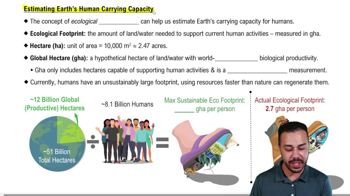
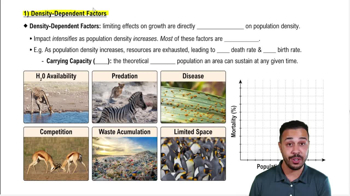
A population's carrying capacity
a. May change as environmental conditions change
b. Can be accurately calculated using the logistic growth model
c. Increases as the per capita population growth rate decreases
d. Can never be exceeded
Scientific study of the population cycles of the snowshoe hare and its predator, the lynx has revealed that
a. Predation is the dominant factor affecting prey population cycling.
b. Hares and lynx are so mutually dependent that each species cannot survive without the other.
c. Both hare and lynx population sizes are affected mainly by abiotic factors.
d. The hare population is r-selected and the lynx population is K-selected.
Analyzing ecological footprints reveals that
a. Earth's carrying capacity would increase if per capita meat consumption increased.
b. Current demand by industrialized countries for resources is much smaller than the ecological footprint of those countries.
c. It is not possible for technological improvements to increase Earth's carrying capacity for humans.
d. The ecological footprint of the United States is large because per capita resource use is high.