
Pearson+ LogoPearson+ Logo
Ch. 53 - Population Ecology
Campbell - Campbell Biology 11th Edition
Urry11th EditionCampbell BiologyISBN: 9789357423311Not the one you use?Change textbook
Chapter 53, Problem 5

Based on current growth rates, Earth's human population in 2019 will be closest to
a. 2.5 million
b. 4.5 billion
c. 7.5 billion
d. 10.5 billion

Verified step by step guidance
1
Understand the context: The problem is asking for an estimate of Earth's human population in 2019 based on current growth rates. This involves understanding population growth trends and historical data.
Review historical population data: Look at the population figures from previous years leading up to 2019. This will help establish a baseline for understanding growth trends.
Consider the growth rate: Research the average annual growth rate of the human population. This rate can be expressed as a percentage increase per year.
Apply the growth rate: Use the growth rate to project the population from the last known figure before 2019. This involves multiplying the previous year's population by the growth rate to estimate the population for 2019.
Compare the estimated population to the options provided: Once you have an estimated figure, compare it to the options given (2.5 million, 4.5 billion, 7.5 billion, 10.5 billion) to determine which is closest to your calculated estimate.

Verified video answer for a similar problem:

This video solution was recommended by our tutors as helpful for the problem above.
Video duration:
1m
Was this helpful?

Key Concepts

Here are the essential concepts you must grasp in order to answer the question correctly.

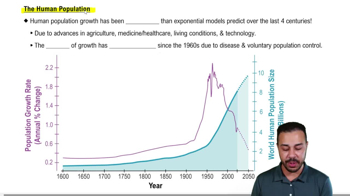
Human Population Growth

Human population growth refers to the increase in the number of individuals in a population. It is influenced by factors such as birth rates, death rates, immigration, and emigration. Understanding current and historical growth trends is essential for predicting future population sizes and addressing challenges related to resource allocation and environmental impact.
Recommended video:
Guided course
02:58
The Human Population

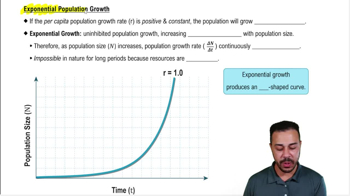
Exponential Growth

Exponential growth occurs when the growth rate of a population is proportional to its current size, leading to faster increases as the population grows. This concept is crucial for understanding how populations can rapidly expand under favorable conditions, often depicted as a J-shaped curve. It contrasts with logistic growth, which considers environmental limits.
Recommended video:
Guided course
03:05
Exponential Population Growth

Demographic Data

Demographic data includes statistical information about populations, such as size, density, distribution, and growth rates. This data is vital for making informed predictions about future population trends and for planning in areas like urban development, healthcare, and resource management. Accurate demographic data helps in understanding the dynamics of population changes over time.
Recommended video:
Guided course
00:43
Population Demography
Related Practice
Textbook Question

A population's carrying capacity

a. May change as environmental conditions change

b. Can be accurately calculated using the logistic growth model

c. Increases as the per capita population growth rate decreases

d. Can never be exceeded

Textbook Question

Scientific study of the population cycles of the snowshoe hare and its predator, the lynx has revealed that

a. Predation is the dominant factor affecting prey population cycling.

b. Hares and lynx are so mutually dependent that each species cannot survive without the other.

c. Both hare and lynx population sizes are affected mainly by abiotic factors.

d. The hare population is r-selected and the lynx population is K-selected.

Textbook Question

Analyzing ecological footprints reveals that

a. Earth's carrying capacity would increase if per capita meat consumption increased.

b. Current demand by industrialized countries for resources is much smaller than the ecological footprint of those countries.

c. It is not possible for technological improvements to increase Earth's carrying capacity for humans.

d. The ecological footprint of the United States is large because per capita resource use is high.

Textbook Question

The observation that members of a population are uniformly distributed suggests that

a. Resources are distributed unevenly.

b. The members of the population are competing for access to a resource.

c. The members of the population are neither attracted to nor repelled by one another.

d. The density of the population is low.

Textbook Question

According to the logistic growth equation


dNdt=rN(Kāˆ’N)K\frac{dN}{dt}=rN\frac{\left(K-N\right)}{K}


a. The number of individuals added per unit time is greatest when N is close to zero.

b. The per capita population growth rate increases as N approaches K.

c. Population growth is zero when N equals K.

d. The population grows exponentially when K is small.

1
views
Textbook Question

During exponential growth, a population always

a. Has a constant per capita population growth rate

b. Quickly reaches its carrying capacity

c. Cycles through time

d. Loses some individuals to emigration