Pearson+ LogoPearson+ Logo
Ch. 49 - Nervous Systems
Campbell - Campbell Biology 11th Edition
Urry11th EditionCampbell BiologyISBN: 9789357423311Not the one you use?Change textbook
Chapter 49, Problem 2

Which of the following structures or regions is incorrectly paired with its function?
a. Limbic system—motor control of speech
b. Medulla oblongata—homeostatic control
c. Cerebellum—coordination of movement and balance
d. Amygdala—emotional memory

Verified step by step guidance
1
Identify the primary function of each brain structure mentioned in the options.
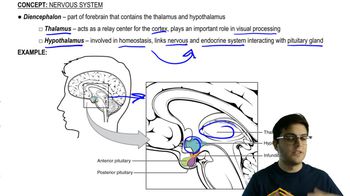
Option a: The limbic system is primarily involved in emotion, behavior, motivation, long-term memory, and olfaction, not motor control of speech.
Option b: The medulla oblongata is responsible for autonomic functions such as breathing, heart rate, and blood pressure regulation, which are part of homeostatic control.
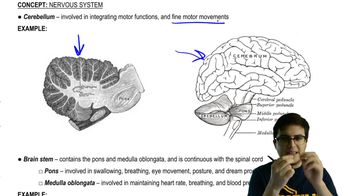
Option c: The cerebellum is involved in the coordination of voluntary movements, balance, and posture.
Option d: The amygdala is involved in processing emotions and emotional memory, which aligns with its function.

Verified video answer for a similar problem:

This video solution was recommended by our tutors as helpful for the problem above.
Video duration:
1m
Was this helpful?

Key Concepts

Here are the essential concepts you must grasp in order to answer the question correctly.

Limbic System

The limbic system is a complex set of structures located in the brain, primarily responsible for emotional responses, memory processing, and motivation. It includes components such as the amygdala and hippocampus. It is not directly involved in motor control of speech, which is primarily managed by areas like Broca's area in the frontal lobe.
Recommended video:
Guided course
04:35
Limbic System

Medulla Oblongata

The medulla oblongata is a part of the brainstem that plays a crucial role in autonomic functions, including the regulation of breathing, heart rate, and blood pressure. It is essential for maintaining homeostasis by controlling involuntary functions necessary for survival. Its role in homeostatic control is well-established.
Recommended video:
Guided course
02:36
Cerebellum and Brainstem

Cerebellum

The cerebellum is a region of the brain located at the back of the skull, responsible for coordinating voluntary movements and maintaining balance and posture. It integrates sensory information to fine-tune motor activity, ensuring smooth and precise movements. Its function in movement coordination and balance is critical.
Recommended video:
Guided course
02:36
Cerebellum and Brainstem