
Pearson+ LogoPearson+ Logo
Ch. 46 - Animal Reproduction
Campbell - Campbell Biology 11th Edition
Urry11th EditionCampbell BiologyISBN: 9789357423311Not the one you use?Change textbook
Chapter 46, Problem 3

Which of the following is not properly paired?
a. Seminiferous tubule—cervix
b. Vas deferens—oviduct
c. Testosterone—estradiol
d. Scrotum—labia majora

Verified step by step guidance
1
Step 1: Begin by understanding the context of the question. It is asking about anatomical and functional pairings between male and female reproductive systems. Each option pairs a male structure with a female structure.
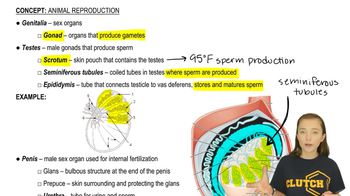
Step 2: Review the male reproductive system. Key structures include the seminiferous tubules (where sperm is produced), vas deferens (which transports sperm), testosterone (a male sex hormone), and the scrotum (which houses the testes).
Step 3: Review the female reproductive system. Key structures include the cervix (the lower part of the uterus), oviduct (also known as the fallopian tube, where fertilization occurs), estradiol (a female sex hormone), and labia majora (external genitalia).
Step 4: Analyze each pairing: a) Seminiferous tubule—cervix: These are unrelated structures; seminiferous tubules are in the male reproductive system, while the cervix is in the female reproductive system. b) Vas deferens—oviduct: Both are transport structures, but they belong to different systems. c) Testosterone—estradiol: Both are sex hormones, one male and one female. d) Scrotum—labia majora: Both are external structures with analogous functions in protecting reproductive organs.
Step 5: Identify the pairing that is not properly matched. The correct answer will be the one where the male and female structures do not have analogous functions or relationships.

Verified video answer for a similar problem:

This video solution was recommended by our tutors as helpful for the problem above.
Video duration:
1m
Was this helpful?

Key Concepts

Here are the essential concepts you must grasp in order to answer the question correctly.

Reproductive Anatomy

Reproductive anatomy refers to the structures involved in the reproductive system of both males and females. In males, key structures include the seminiferous tubules, vas deferens, and scrotum, while in females, the cervix, oviduct, and labia majora are essential components. Understanding these structures and their functions is crucial for identifying correct pairings in reproductive biology.
Recommended video:
Guided course
11:56
Male Reproductive Anatomy

Hormonal Regulation

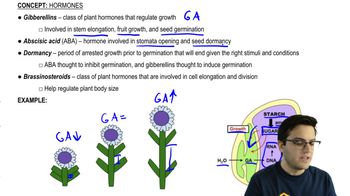
Hormonal regulation in reproduction involves the interplay of hormones such as testosterone and estradiol, which are critical for the development and functioning of reproductive organs. Testosterone is primarily associated with male characteristics and reproductive functions, while estradiol is a form of estrogen important for female reproductive health. Recognizing the roles of these hormones helps clarify their relationships and pairings.
Recommended video:
Guided course
08:18
Plant Hormones and Senescence

Pairing Relationships

Pairing relationships in biology often refer to the correct associations between structures or functions within a system. In the context of reproductive anatomy, this involves understanding which male and female structures correspond to each other. Identifying incorrect pairings, such as those listed in the question, requires a solid grasp of reproductive anatomy and hormonal functions.
Recommended video:
04:12
Phylogeny Example 3