
Pearson+ LogoPearson+ Logo
Ch. 45 - Hormones and the Endocrine System
Campbell - Campbell Biology 11th Edition
Urry11th EditionCampbell BiologyISBN: 9789357423311Not the one you use?Change textbook
Chapter 45, Problem 7

The relationship between the insect hormones ecdysteroid and PTTH is an example of
a. An interaction of the endocrine and nervous systems.
b. Homeostasis achieved by positive feedback.
c. Homeostasis maintained by antagonistic hormones.
d. Competitive inhibition of a hormone receptor.

Verified step by step guidance
1
Identify the roles of ecdysteroid and PTTH in insect physiology. Ecdysteroid is a hormone that promotes molting and metamorphosis in insects, while PTTH (prothoracicotropic hormone) stimulates the production of ecdysteroid.
Understand the interaction between the endocrine and nervous systems. The nervous system can influence the endocrine system by releasing hormones like PTTH, which in turn affects the production of other hormones such as ecdysteroid.
Consider the concept of homeostasis and how it is maintained in biological systems. Homeostasis involves maintaining a stable internal environment, often through feedback mechanisms.
Evaluate the types of feedback mechanisms: positive feedback amplifies changes, while negative feedback reduces them. Determine if the interaction between ecdysteroid and PTTH fits either of these descriptions.
Analyze the options given: a) interaction of the endocrine and nervous systems, b) positive feedback, c) antagonistic hormones, and d) competitive inhibition. Consider which option best describes the relationship between ecdysteroid and PTTH based on their roles and interactions.

Verified video answer for a similar problem:

This video solution was recommended by our tutors as helpful for the problem above.
Video duration:
3m
Was this helpful?

Key Concepts

Here are the essential concepts you must grasp in order to answer the question correctly.

Endocrine and Nervous System Interaction

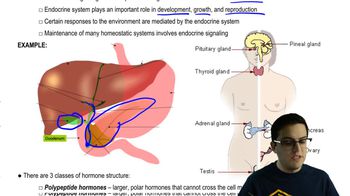
The endocrine and nervous systems interact to regulate physiological processes. The nervous system can trigger hormone release, while hormones can affect neural activity. This interaction is crucial for coordinating complex body functions, such as growth and stress responses, by integrating signals from both systems.
Recommended video:
Guided course
05:55
Endocrine System

Homeostasis and Feedback Mechanisms

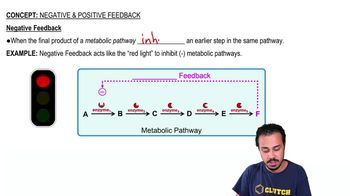
Homeostasis refers to the maintenance of a stable internal environment in an organism. Feedback mechanisms, such as positive and negative feedback, are essential for homeostasis. Positive feedback amplifies changes, while negative feedback counteracts them, ensuring that physiological parameters remain within a narrow range.
Recommended video:
Guided course
02:41
Negative Feedback

Antagonistic Hormones

Antagonistic hormones are pairs of hormones that have opposite effects on physiological processes. This balance helps maintain homeostasis. For example, insulin and glucagon are antagonistic hormones that regulate blood glucose levels, with insulin lowering and glucagon raising glucose concentrations in the blood.
Recommended video:
Guided course
08:18
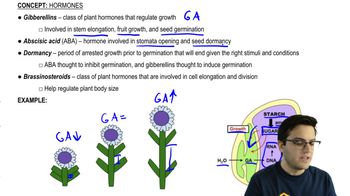
Plant Hormones and Senescence