Pearson+ LogoPearson+ Logo
Ch. 44 - Osmoregulation and Excretion
Campbell - Campbell Biology 11th Edition
Urry11th EditionCampbell BiologyISBN: 9789357423311Not the one you use?Change textbook
Chapter 44, Problem 5

In which of the following species should natural selection favor the highest proportion of juxtamedullary nephrons?
a. A river otter
b. A mouse species living in a temperate broadleaf forest
c. A mouse species living in a desert
d. A beaver

Verified step by step guidance
1
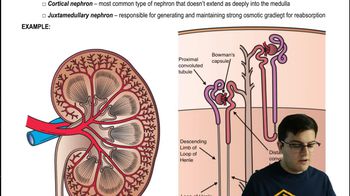
Understand the function of juxtamedullary nephrons: These nephrons are specialized for water reabsorption and are crucial for producing concentrated urine, which is important for conserving water.
Consider the habitat of each species: Juxtamedullary nephrons are more beneficial in environments where water is scarce, as they help in conserving water by concentrating urine.
Analyze the options: a river otter and a beaver live in aquatic environments where water is abundant, so they are less likely to need a high proportion of juxtamedullary nephrons.
Evaluate the mouse species: The mouse species living in a temperate broadleaf forest has moderate water availability, while the mouse species living in a desert faces extreme water scarcity.
Conclude which species would benefit most: Natural selection would favor the highest proportion of juxtamedullary nephrons in the mouse species living in a desert, as it needs to conserve water in its arid environment.

Verified video answer for a similar problem:

This video solution was recommended by our tutors as helpful for the problem above.
Video duration:
56s
Was this helpful?

Key Concepts

Here are the essential concepts you must grasp in order to answer the question correctly.

Juxtamedullary Nephrons

Juxtamedullary nephrons are specialized structures in the kidneys that play a crucial role in concentrating urine. They have long loops of Henle that extend deep into the medulla, allowing for efficient reabsorption of water and solutes. This adaptation is particularly beneficial for species living in environments where water conservation is essential.
Recommended video:
Guided course
02:59
Kidney and Nephron

Natural Selection

Natural selection is a fundamental mechanism of evolution, where individuals with traits better suited to their environment tend to survive and reproduce more successfully. Over time, these advantageous traits become more common in the population. In the context of kidney function, natural selection would favor adaptations that enhance survival in specific habitats, such as efficient water conservation in arid environments.
Recommended video:
04:43
Natural Selection

Desert Adaptations

Desert adaptations are physiological and behavioral traits that enable organisms to survive in arid environments with limited water availability. These adaptations may include efficient water retention, reduced water loss, and specialized kidney functions like those provided by juxtamedullary nephrons. Species living in deserts often evolve such traits to maintain hydration and survive extreme conditions.
Recommended video:
Guided course
03:54
Desert and Savanna