Pearson+ LogoPearson+ Logo
Ch. 35 - Vascular Plant Structure, Growth, and Development
Campbell - Campbell Biology 11th Edition
Urry11th EditionCampbell BiologyISBN: 9789357423311Not the one you use?Change textbook
Chapter 35, Problem 3

Heartwood and sapwood consist of
a. Bark
b. Periderm
c. Secondary xylem
d. Secondary phloem

Verified step by step guidance
1
Understand the structure of a tree: Trees have several layers including bark, periderm, xylem, and phloem. Each layer has a specific function and composition.
Identify the role of xylem: Xylem is responsible for transporting water and nutrients from the roots to the rest of the tree. It is divided into heartwood and sapwood.
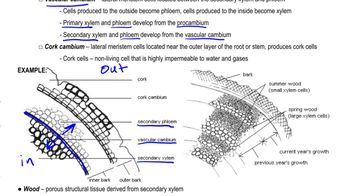
Differentiate between heartwood and sapwood: Heartwood is the central, non-living part of the tree, providing structural support. Sapwood is the outer, living part of the xylem, actively involved in transport.
Recognize the composition of heartwood and sapwood: Both heartwood and sapwood are composed of secondary xylem, which is formed during the secondary growth of the tree.
Conclude that heartwood and sapwood consist of secondary xylem, which is option c.

Verified video answer for a similar problem:

This video solution was recommended by our tutors as helpful for the problem above.
Video duration:
27s
Was this helpful?

Key Concepts

Here are the essential concepts you must grasp in order to answer the question correctly.

Heartwood and Sapwood

Heartwood and sapwood are parts of a tree's secondary xylem. Heartwood is the central, non-living part that provides structural support, while sapwood is the outer, living part that transports water and nutrients. Understanding their roles helps in identifying the correct answer related to tree anatomy.
Recommended video:
Guided course
06:53
Secondary Growth

Secondary Xylem

Secondary xylem is the tissue responsible for water conduction and structural support in woody plants. It forms through the process of secondary growth, which increases the girth of stems and roots. Heartwood and sapwood are both components of secondary xylem, crucial for understanding their function in trees.
Recommended video:
Guided course
06:53
Secondary Growth

Tree Anatomy

Tree anatomy includes various layers such as bark, periderm, secondary xylem, and secondary phloem. Each layer has distinct functions, with secondary xylem being vital for water transport and support. Recognizing these layers helps in distinguishing between heartwood and sapwood and their respective roles.
Recommended video:
04:35
Building Phylogenetic Trees Example 1