Pearson+ LogoPearson+ Logo
Ch. 32 - An Overview of Animal Diversity
Campbell - Campbell Biology 11th Edition
Urry11th EditionCampbell BiologyISBN: 9789357423311Not the one you use?Change textbook
Chapter 32, Problem 3

Which of the following was probably the least important factor in bringing about the Cambrian explosion?
a. The emergence of predator-prey relationships
b. An increase in the concentration of atmospheric oxygen
c. The movement of animals onto land
d. The origin of Hox genes

Verified step by step guidance
1
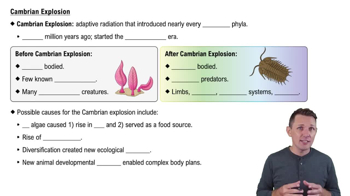
Understand the Cambrian explosion: It was a period approximately 541 million years ago when most major animal phyla appeared in the fossil record. This event is characterized by a rapid diversification of life forms.
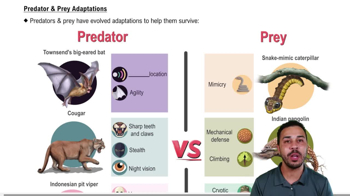
Consider the role of predator-prey relationships: The emergence of these relationships likely drove evolutionary changes, leading to adaptations and diversification of species.
Evaluate the increase in atmospheric oxygen: Higher oxygen levels could support more complex organisms and metabolic processes, contributing to the diversification during the Cambrian explosion.
Examine the movement of animals onto land: This factor is less relevant to the Cambrian explosion, as the event primarily involved marine life. The transition to land occurred later in evolutionary history.
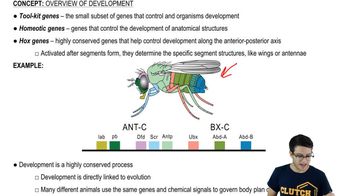
Analyze the origin of Hox genes: Hox genes are crucial for the development of body plans in animals. Their origin and diversification could have played a significant role in the morphological diversity seen during the Cambrian explosion.

Verified video answer for a similar problem:

This video solution was recommended by our tutors as helpful for the problem above.
Video duration:
54s
Was this helpful?

Key Concepts

Here are the essential concepts you must grasp in order to answer the question correctly.

Cambrian Explosion

The Cambrian Explosion refers to a period approximately 541 million years ago when there was a rapid diversification of life forms on Earth. This event is marked by the sudden appearance of most major animal phyla in the fossil record, indicating significant evolutionary changes. Understanding this period is crucial for analyzing factors that contributed to the diversification of life.
Recommended video:
05:10
Cambrian Explosion

Predator-Prey Relationships

Predator-prey relationships are interactions between two species where one species (the predator) hunts and consumes the other (the prey). These relationships can drive evolutionary changes, such as the development of defense mechanisms and adaptations in prey species, and hunting strategies in predators, potentially influencing biodiversity during the Cambrian Explosion.
Recommended video:
Guided course
03:01
Predator & Prey Adaptations

Hox Genes

Hox genes are a group of related genes that determine the basic structure and orientation of an organism. They play a critical role in the development of body plans during embryonic development. The origin and diversification of Hox genes are believed to have contributed to the complexity and variety of life forms during the Cambrian Explosion by enabling more complex body structures.
Recommended video: