Pearson+ LogoPearson+ Logo
Ch. 30 - Plant Diversity II: The Evolution of Seed Plants
Campbell - Campbell Biology 11th Edition
Urry11th EditionCampbell BiologyISBN: 9789357423311Not the one you use?Change textbook
Chapter 30, Problem 2

Key features of seed plants facilitating life on land include three of the following four traits. Select the exception.
a. Homospory
b. Pollen
c. Reduced gametophytes
d. Seeds

Verified step by step guidance
1
Understand the key features of seed plants that facilitate life on land. These features include adaptations that help plants survive and reproduce in terrestrial environments.
Identify the concept of 'homospory'. Homospory refers to the production of spores of one kind only, which are not differentiated by sex. This is typically seen in non-seed plants like ferns.
Recognize the role of 'pollen' in seed plants. Pollen grains are male gametophytes that facilitate the transfer of sperm to the female gametophyte without the need for water, a crucial adaptation for life on land.
Understand 'reduced gametophytes'. In seed plants, the gametophyte generation is reduced and often dependent on the sporophyte, which provides protection and nutrients, aiding survival in terrestrial habitats.
Learn about 'seeds'. Seeds contain the embryo and a food supply, encased in a protective coat, allowing plants to survive harsh conditions and disperse offspring effectively.

Verified video answer for a similar problem:

This video solution was recommended by our tutors as helpful for the problem above.
Video duration:
1m
Was this helpful?

Key Concepts

Here are the essential concepts you must grasp in order to answer the question correctly.

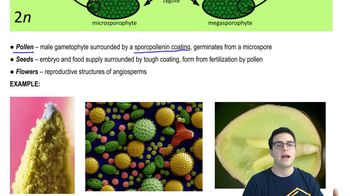
Homospory

Homospory refers to the production of spores of a single type, which is typical in non-seed plants like ferns. These spores develop into bisexual gametophytes, which produce both male and female gametes. In seed plants, heterospory is more common, where two distinct types of spores are produced, leading to separate male and female gametophytes.
Recommended video:
Guided course
06:17
Land Plants - 4

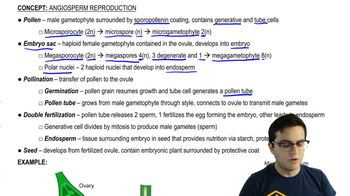
Pollen

Pollen is a key adaptation in seed plants that facilitates reproduction without the need for water. It consists of male gametophytes enclosed within a protective coat, allowing them to be transported by wind or animals to reach female gametophytes. This adaptation is crucial for life on land, enabling fertilization over greater distances and in diverse environments.
Recommended video:
Guided course
07:44
Double Fertilization

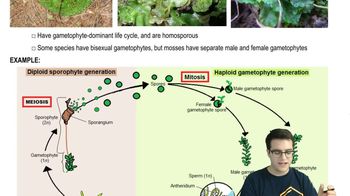
Reduced Gametophytes

Reduced gametophytes in seed plants refer to the minimization of the gametophyte stage, which is dependent on the sporophyte. This reduction is advantageous for terrestrial life as it protects the gametophytes from environmental stresses and allows for efficient nutrient transfer from the sporophyte, enhancing survival and reproduction.
Recommended video:
Guided course
06:16
Nonvascular Plants - 1