Pearson+ LogoPearson+ Logo
Ch. 23 - The Evolution of Populations
Campbell - Campbell Biology 11th Edition
Urry11th EditionCampbell BiologyISBN: 9789357423311Not the one you use?Change textbook
Chapter 23, Problem 2

No two people are genetically identical, except for identical twins. The main source of genetic variation among humans is
a. New mutations that occurred in the preceding generation.
b. Genetic drift.
c. The reshuffling of alleles in sexual reproduction.
d. Environmental effects.

Verified step by step guidance
1
Understand the concept of genetic variation: Genetic variation refers to the differences in DNA sequences among individuals within a population. This variation is crucial for evolution and adaptation.
Consider the role of mutations: Mutations are changes in the DNA sequence that can introduce new genetic variations. They occur randomly and can be passed to the next generation if they occur in germ cells.
Explore genetic drift: Genetic drift is a mechanism of evolution that refers to random changes in allele frequencies in a population. It can lead to genetic variation but is more significant in small populations.
Examine the reshuffling of alleles in sexual reproduction: During sexual reproduction, alleles are reshuffled through processes like meiosis and fertilization, leading to new combinations of genes in offspring. This is a major source of genetic variation.
Consider environmental effects: Environmental factors can influence gene expression and phenotype but do not directly change the genetic code. They can lead to phenotypic variation but are not a primary source of genetic variation.

Verified video answer for a similar problem:

This video solution was recommended by our tutors as helpful for the problem above.
Video duration:
1m
Was this helpful?

Key Concepts

Here are the essential concepts you must grasp in order to answer the question correctly.

Genetic Variation

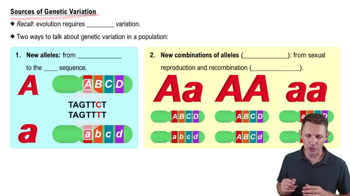
Genetic variation refers to the differences in DNA sequences among individuals within a population. It is crucial for evolution and adaptation, as it provides the raw material for natural selection. Variation arises from mutations, gene flow, and sexual reproduction, leading to diverse traits that can affect an organism's survival and reproduction.
Recommended video:
02:16
Sources of Genetic Variation

Mutations

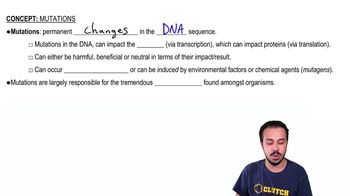
Mutations are changes in the DNA sequence that can occur spontaneously or due to environmental factors. They are a primary source of genetic variation, introducing new alleles into a population. While many mutations are neutral or harmful, some can be beneficial and increase an organism's fitness, contributing to evolutionary change.
Recommended video:

Allele Shuffling in Sexual Reproduction

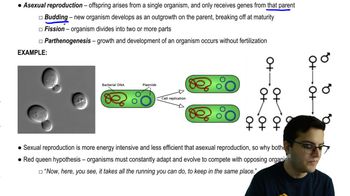
During sexual reproduction, alleles are reshuffled through processes like independent assortment and crossing over during meiosis. This reshuffling creates new combinations of alleles in offspring, contributing significantly to genetic diversity. It ensures that each individual has a unique genetic makeup, except in the case of identical twins.
Recommended video:
Guided course
05:44
Sexual and Asexual Reproduction