
Pearson+ LogoPearson+ Logo
Ch. 20 - DNA Tools and Biotechnology
Campbell - Campbell Biology 11th Edition
Urry11th EditionCampbell BiologyISBN: 9789357423311Not the one you use?Change textbook
Chapter 20, Problem 6

Which of the following is not true of cDNA produced using human brain tissue as the starting material?
a. It can be amplified by the polymerase chain reaction.
b. It was produced from pre-mRNA using reverse transcriptase.
c. It can be labeled and used as a probe to detect genes expressed in the brain.
d. It lacks the introns of the pre-mRNA.

Verified step by step guidance
1
Understand what cDNA is: cDNA, or complementary DNA, is synthesized from an mRNA template using the enzyme reverse transcriptase. This process involves converting the RNA sequence into a DNA sequence.
Consider the role of reverse transcriptase: Reverse transcriptase is an enzyme that synthesizes cDNA from an RNA template. This means that cDNA is derived from mature mRNA, which does not contain introns, as introns are removed during RNA processing.
Evaluate option a: cDNA can indeed be amplified by the polymerase chain reaction (PCR) because it is a DNA sequence, and PCR is a technique used to amplify DNA.
Evaluate option b: cDNA is produced from mature mRNA, not pre-mRNA. Pre-mRNA contains introns, which are spliced out to form mature mRNA before reverse transcription occurs.
Evaluate option c and d: cDNA can be labeled and used as a probe to detect gene expression, and it lacks introns because it is synthesized from mature mRNA. Therefore, option b is not true because cDNA is not produced from pre-mRNA.

Verified video answer for a similar problem:

This video solution was recommended by our tutors as helpful for the problem above.
Video duration:
1m
Was this helpful?

Key Concepts

Here are the essential concepts you must grasp in order to answer the question correctly.

cDNA and Reverse Transcriptase

cDNA, or complementary DNA, is synthesized from an mRNA template using the enzyme reverse transcriptase. This process involves converting the single-stranded RNA into double-stranded DNA, which is crucial for studying gene expression. cDNA lacks introns because it is derived from processed mRNA, which has already undergone splicing to remove introns.
Recommended video:
Guided course
04:16
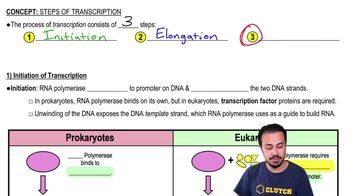
1) Initiation of Transcription

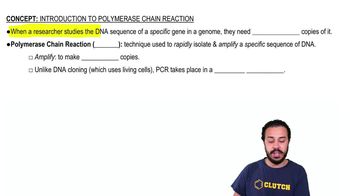
Polymerase Chain Reaction (PCR)

The polymerase chain reaction (PCR) is a technique used to amplify specific DNA sequences, making millions of copies from a small initial sample. This method is essential for analyzing small amounts of DNA, such as cDNA, allowing for further study or use in various applications like cloning or sequencing. PCR requires primers, nucleotides, and a DNA polymerase enzyme to replicate the target DNA.
Recommended video:
Guided course
01:31
Introduction to Polymerase Chain Reaction

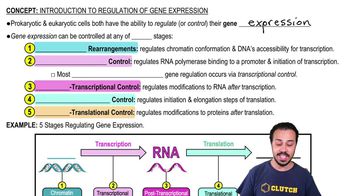
Gene Expression and Probes

Gene expression refers to the process by which information from a gene is used to synthesize functional gene products like proteins. cDNA can be labeled with radioactive or fluorescent tags to serve as probes, which are used to detect specific gene sequences in various samples. This technique helps identify which genes are active in particular tissues, such as the brain, by hybridizing the labeled cDNA to complementary sequences.
Recommended video:
Guided course
06:40
Introduction to Regulation of Gene Expression
Related Practice
Textbook Question

Plants are more readily manipulated by genetic engineering than are animals because

a. Plant genes do not contain introns.

b. More vectors are available for transferring recombinant DNA into plant cells.

c. A somatic plant cell can often give rise to a complete plant.

d. Plant cells have larger nuclei.

Textbook Question

A paleontologist has recovered a bit of tissue from the 400-year-old preserved skin of an extinct dodo (a bird). To compare a specific region of the DNA from a sample with DNA from living birds, which of the following would be most useful for increasing the amount of dodo DNA available for testing?

a. SNP analysis

b. Polymerase chain reaction (PCR)

c. Electroporation

d. Gel electrophoresis

Textbook Question

DNA technology has many medical applications. Which of the following is not done routinely at present?

a. Production of hormones for treating diabetes and dwarfism

b. Analysis of gene expression for more informed cancer treatments

c. Gene editing by the CRISPR-Cas9 system in viable human embryos to correct genetic diseases

d. Prenatal identification of genetic disease alleles

Textbook Question

Expression of a cloned eukaryotic gene in a bacterial cell involves many challenges. The use of mRNA and reverse transcriptase is part of a strategy to solve the problem of

a. Post-transcriptional processing.

b. Post-translational processing.

c. Nucleic acid hybridization.

d. Restriction fragment ligation.

Textbook Question

Which of the following sequences in double-stranded DNA is most likely to be recognized as a cutting site for a restriction enzyme?

a. AAGG TTCC

b. GGCC CCGG

c. ACCA TGGT

d. AAAA TTTT