Pearson+ LogoPearson+ Logo
Ch. 14 - Mendel and the Gene Idea
Campbell - Campbell Biology 11th Edition
Urry11th EditionCampbell BiologyISBN: 9789357423311Not the one you use?Change textbook
Chapter 14, Problem 5

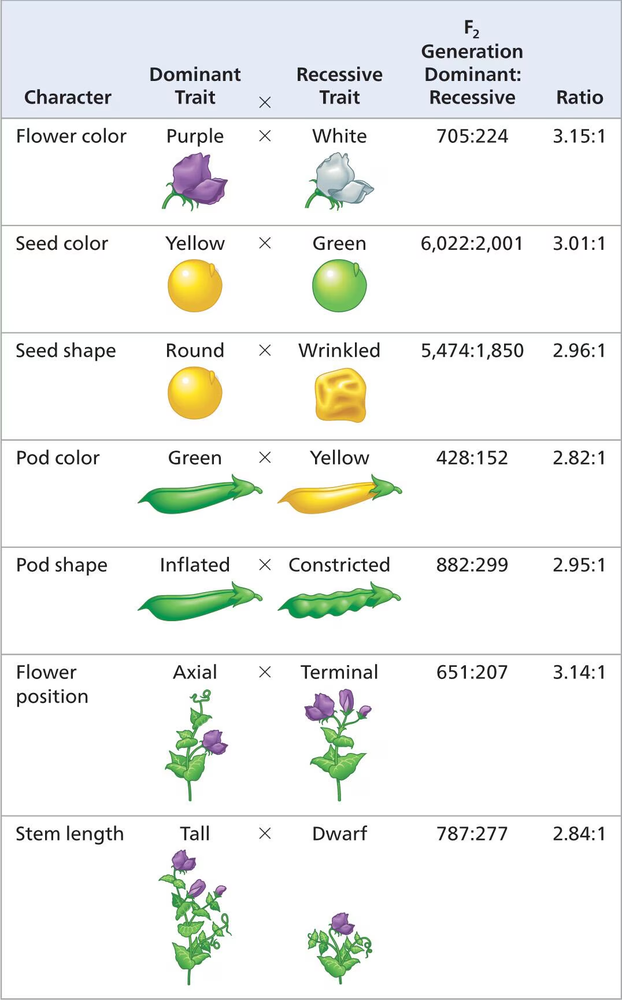
Flower position, stem length, and seed shape are three characters that Mendel studied. Each is controlled by an independently assorting gene and has dominant and recessive expression as indicated in Table 14.1.


Table showing dominant and recessive traits in pea plants with F2 generation ratios for flower color, seed color, and more.


If a plant that is heterozygous for all three characters is allowed to self-fertilize, what proportion of the offspring would you expect to be each of the following? (Note: Use the rules of probability instead of a huge Punnett square.)
a. Homozygous for the three dominant traits
b. Homozygous for the three recessive traits
c. Heterozygous for all three characters
d. Homozygous for axial and tall, heterozygous for seed shape

Verified step by step guidance
1
Identify the genotypes for each trait: For flower position, axial (A) is dominant over terminal (a). For stem length, tall (T) is dominant over dwarf (t). For seed shape, round (R) is dominant over wrinkled (r). A heterozygous plant for all three traits would have the genotype AaTtRr.
Use the rules of probability to determine the proportion of offspring for each scenario. For each trait, calculate the probability of being homozygous dominant, homozygous recessive, or heterozygous. Since the genes assort independently, multiply the probabilities for each trait to find the overall probability for the combination of traits.
For part a, calculate the probability of being homozygous dominant (AA, TT, RR). The probability of AA is 1/4, TT is 1/4, and RR is 1/4. Multiply these probabilities together to find the overall probability for homozygous dominant.
For part b, calculate the probability of being homozygous recessive (aa, tt, rr). The probability of aa is 1/4, tt is 1/4, and rr is 1/4. Multiply these probabilities together to find the overall probability for homozygous recessive.
For part c, calculate the probability of being heterozygous for all three characters (Aa, Tt, Rr). The probability of Aa is 1/2, Tt is 1/2, and Rr is 1/2. Multiply these probabilities together to find the overall probability for heterozygous for all three characters.

Verified video answer for a similar problem:

This video solution was recommended by our tutors as helpful for the problem above.
Video duration:
2m
Was this helpful?

Key Concepts

Here are the essential concepts you must grasp in order to answer the question correctly.

Mendelian Genetics

Mendelian genetics refers to the principles of heredity discovered by Gregor Mendel, which include the laws of segregation and independent assortment. These laws explain how traits are inherited through dominant and recessive alleles, and how genes for different traits segregate independently during gamete formation, leading to genetic variation.
Recommended video:
04:26
Mendelian and Population Genetics

Independent Assortment

Independent assortment is a key principle of Mendelian genetics stating that genes for different traits are inherited independently of each other. This occurs during meiosis when homologous chromosomes are randomly distributed to gametes, allowing for various combinations of traits in offspring, which is crucial for calculating probabilities in genetic crosses.
Recommended video:
Guided course
08:49
Independent Assortment

Probability in Genetics

Probability in genetics involves using mathematical principles to predict the likelihood of specific genotypes and phenotypes in offspring. By applying the rules of probability, such as multiplication and addition rules, one can calculate the expected proportions of different genetic combinations without constructing extensive Punnett squares, especially in complex crosses.
Recommended video:
Guided course
03:38
Punnett Square Probability
Related Practice
Textbook Question

A man with type A blood marries a woman with type B blood. Their child has type O blood. What are the genotypes of these three individuals? What genotypes, and in what frequencies, would you expect in future offspring from this marriage?

1
views
Textbook Question

A man has six fingers on each hand and six toes on each foot. His wife and their daughter have the normal number of digits. Remember that extra digits is a dominant trait. What fraction of this couple's children would be expected to have extra digits?

Textbook Question

A pea plant heterozygous for inflated pods (Ii) is crossed with a plant homozygous for constricted pods (ii). Draw a Punnett square for this cross to predict genotypic and phenotypic ratios. Assume that pollen comes from the ii plant.

Textbook Question

Hemochromatosis is an inherited disease caused by a recessive allele. If a woman and her husband, who are both carriers, have three children, what is the probability of each of the following?

a. All three children are of normal phenotype

b. One or more of the three children have the disease

c. All three children have the disease

d. At least one child is phenotypically normal

Textbook Question

The genotype of F1 individuals in a tetrahybrid cross is AaBbCcDd. Assuming independent assortment of these four genes, what are the probabilities that F2 offspring will have the following genotypes?

a. aabbccdd

b. AaBbCcDd

c. AABBCCDD

d. AaBBccDd

e. AaBBCCdd

1
views
Textbook Question

What is the probability that each of the following pairs of parents will produce the indicated offspring? (Assume independent assortment of all gene pairs.)

a. AABBCC×aabbcc→AaBbCc

b. AABbCc×AaBbCc→AAbbCC

c. AaBbCc×AaBbCc→AaBbCc

d. aaBbCC×AABbcc→AaBbCc